


Greater Long Island coverage is funded in part by Toresco & Simonelli, a boutique injury and family law firm in West Islip. They fight for their clients. Click here to get in touch.
Stricter recordkeeping, limits on hourly room rentals, and mandatory employee training are at the core of a new Suffolk County law aimed at curbing human sex trafficking in hotels and motels.
The Suffolk County Legislature has unanimously approved the new legislation that will tighten hotel and motel regulations across the county. It’s a move lawmakers and advocates insist will help disrupt a predatory and insidious crime that has increasingly surfaced in local communities.
The measure, sponsored by Leg. Chad Lennon, now heads to County Executive Ed Romaine, who has said he will sign it into law.
Under the legislation, hotels and motels in Suffolk County will be required to digitally maintain guest records, including copies of photo identification, for up to five years.
Security camera footage must also be retained for at least 90 days and made available to law enforcement, emergency responders and authorized officials when necessary. Operators who do not comply face significantly increased fines, with penalties rising up to $10,000 for repeat violations.
The law also prohibits hotels and motels from offering hourly room rates of less than six hours for rooms with sleeping accommodations. Short-term rentals is a practice that has long been exploited by traffickers who seek anonymity and quick turnover, lawmakers said.
“Together we as a county are working to face the issue of human trafficking head on,” Lennon said following the vote, calling the bill a first step in a broader legislative effort to protect vulnerable individuals.
Presiding Officer Kevin McCaffrey said the bipartisan vote reflects growing recognition that trafficking is not a distant problem, but one acutely affecting communities across Suffolk County.
“Trafficking is a persistent and pernicious crime that extends to all demographics and communities,” McCaffrey said. “And it must be stopped.”
The legislation comes amid heightened scrutiny of human trafficking on Long Island.
Earlier this year, Suffolk County officials announced a coordinated, multi-agency effort involving law enforcement, social services, and advocacy groups aimed at identifying victims and prosecuting traffickers more effectively. The initiative followed several high-profile cases, including the 2024 disappearance of a 14-year-old Patchogue girl who was later found to have been trafficked, leading to more than a dozen arrests.
County officials have said cases like the Patchogue girl’s underscore the role hotels and motels can play, knowingly or unknowingly, in facilitating trafficking activity. Stronger oversight is absolutely necessary, they said.
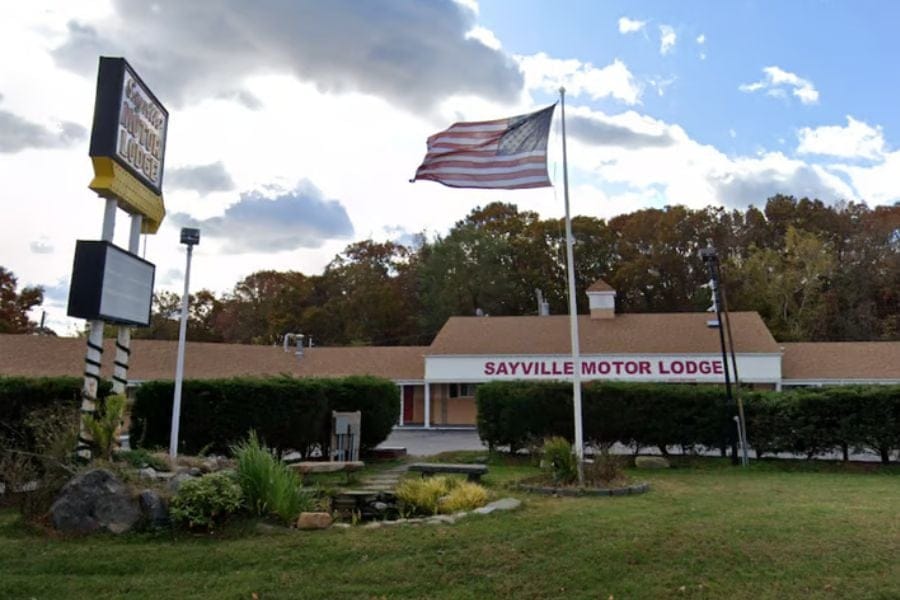
In recent months, six people, including the owners of the now-closed Sayville Motor Lodge, have been convicted in a sex trafficking ring that operated out of the motel. Prosecutors said the group used force, fraud and coercion to exploit vulnerable women, many struggling with drug addiction, forcing them into commercial sex acts and controlling their earnings.
The traffickers also manipulated victims with drugs, set prices and ads, isolated them, and subjected them to physical and emotional abuse. Authorities described the operation as violent and deeply exploitative.
The motel had been at the center of a broader trafficking and narcotics conspiracy for nearly a decade. Following the 2022 arrests, the property was seized, later sold, and some proceeds were set aside for victim compensation.
In a recent special report, Newsday found that sex traffickers utilize dozens and dozens of motels and hotels across Long Island.
In addition to recordkeeping and rental restrictions, the new law requires hotel operators to provide human trafficking recognition training to core employees. That includes front desk staff and housekeeping personnel.
Training records must be maintained and submitted quarterly to the county’s Department of Labor, Licensing and Consumer Affairs.
Romaine said the measure is an important step toward limiting the anonymity traffickers rely on.
“Suffolk County will stay vigilant and do all we can to prevent and, if needed, prosecute the heinous crime of human trafficking,” Romaine said. “Legislator Lennon’s bill an important step in preventing anonymity and potential havens for traffickers. Too many are being harmed by some very bad people.”
The law will take effect immediately upon filing with the New York secretary of state.
Top photo: Exterior of the now-closed Sayville Motor Lodge on Sunrise Highway in Sayville (credit: Google Maps).

Your Long Island news, delivered.
Subscribe to the GLI Newsletter — its free