


Greater Long Island coverage is funded in part by Toresco & Simonelli, a boutique injury and family law firm in West Islip. They fight for their clients. Click here to get in touch.
Red foxes and Eastern coyotes have established territories across Nassau and Suffolk counties.
But it could be tough to tell them apart.
“Sightings are typically fleeting for most people,” said Frank Vincenti of the Wild Dog Foundation, a not-for-profit environmental conservation group. “Unless the animal is standing there, waiting for you to take a picture, it can be hard to discern.”
The Wildlife Foundation works to educate the public on living with foxes and coyotes, so Greater Long Island reached out to Vincenti for help — especially after sightings poured into the newsroom following this report on coyotes first published to GLI in the spring.
Some of the reader sightings were indeed of Eastern coyotes, but some were red foxes. Few people were able to tell the difference.
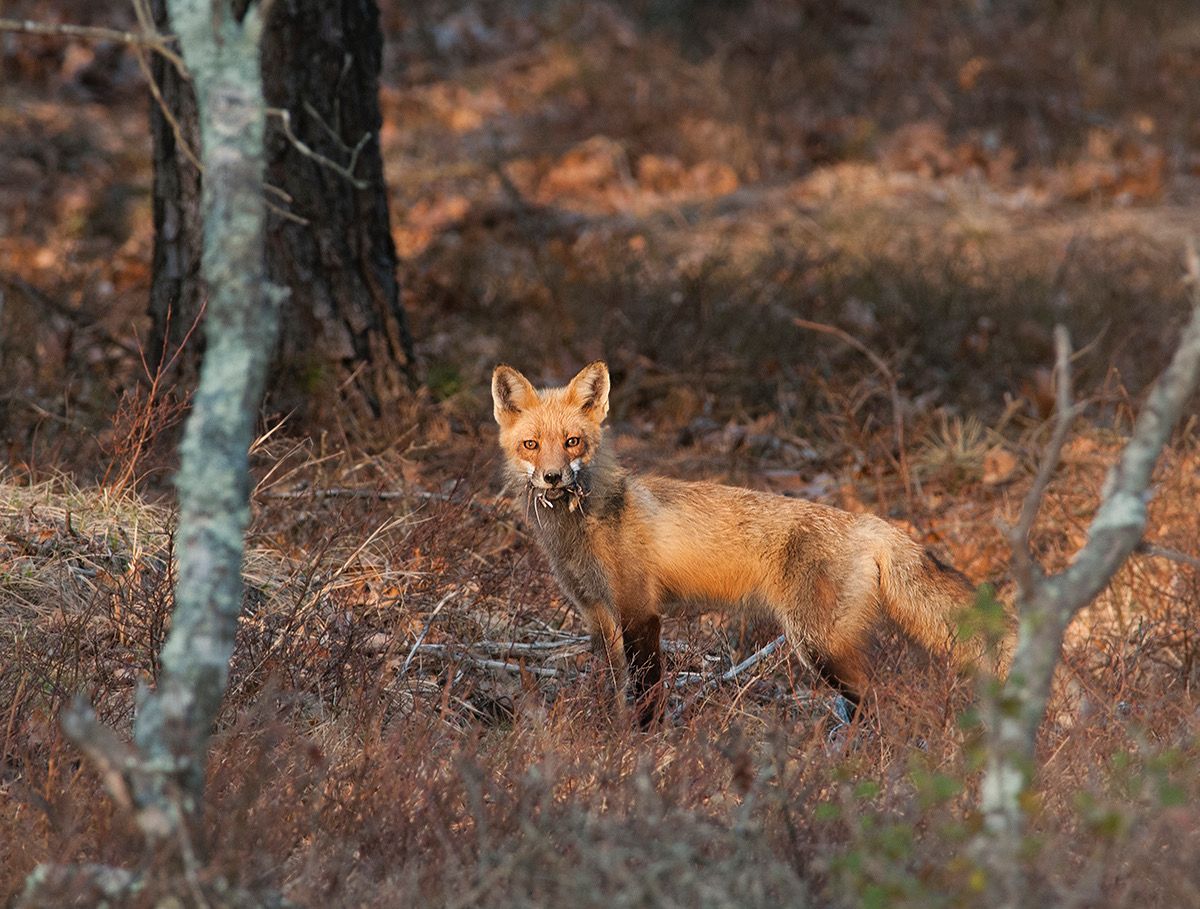
Top: Red fox photographed in Calverton, N.Y. (Credit: Luke Ormand.)
The ‘tell-tail’ signs
Both animals are swift and elusive. But, if you do have access to photos or a video to review more carefully, there are some —mostly consistent — differences that you’ll notice.
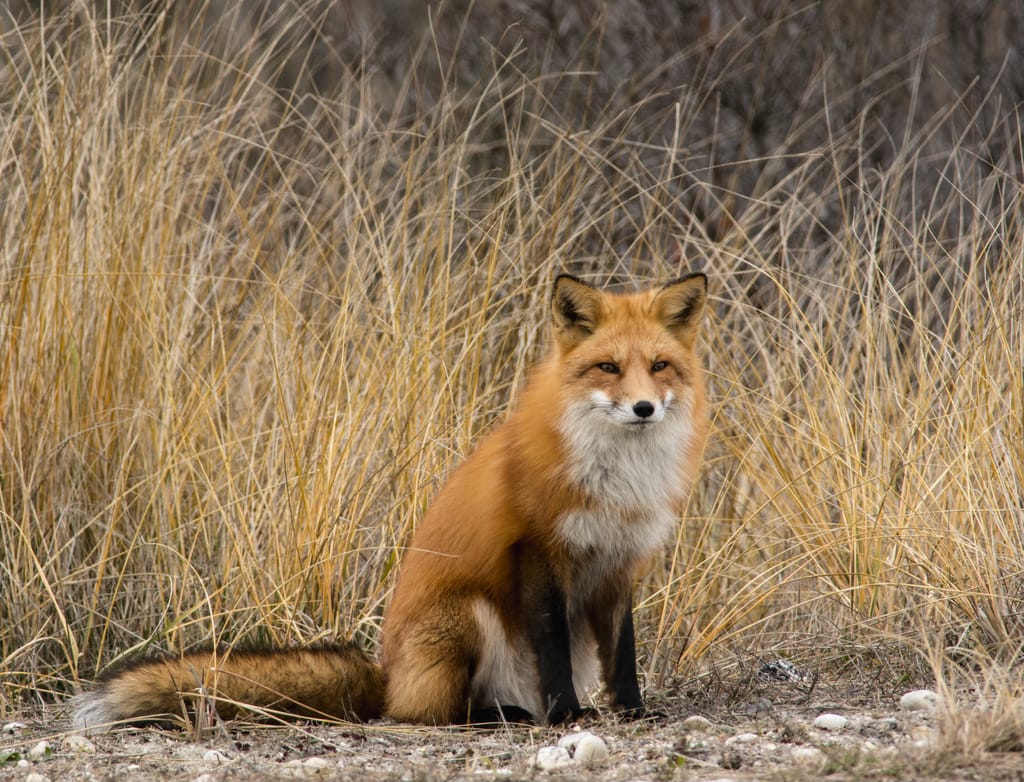
Typically, the red fox will have black coloration toward the bottom of its legs. These are called the “boots” and are sort of its signature.
The fox will also have a white tip on its tail, whereas the coyote usually has a black tip.
But not always with the coyotes.
“Either species can have a white tail tip,” Vincenti said, “but it’s generally the tell-tale sign of a red fox.”
You can see the boots and white tail tip in this video a GLI reader sent us from Massapequa Park (swipe left):
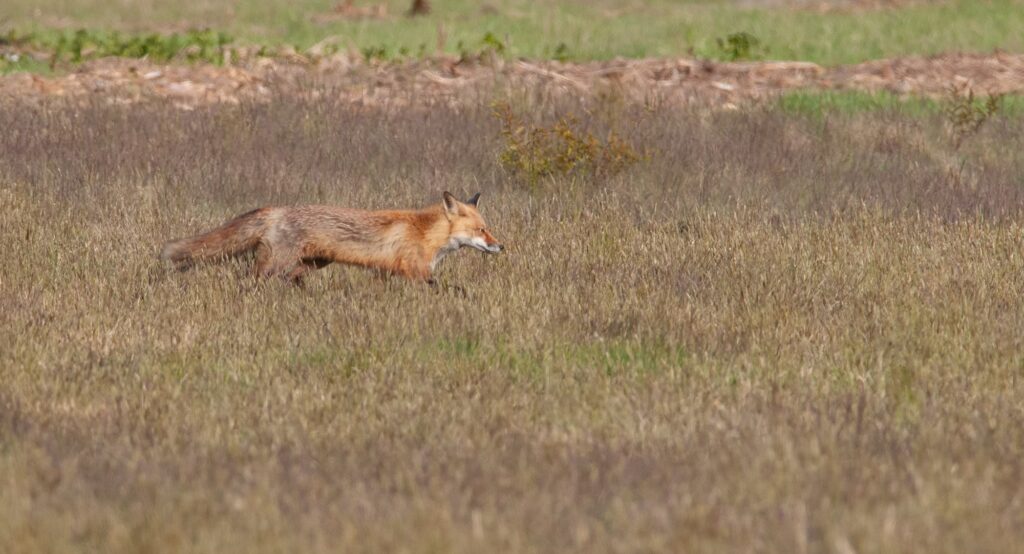
The foxes also have longer tails, with respect to the animal’s overall size.
“The fox’s tail is as long, if not longer, than it’s torso and will easily touch the ground in a relaxed state,” Vincenti said. “With coyotes, they’re like little wolves so their tails will just go down to the beginning of their ankles.”
You can see a coyote and assess its tail size in this video a GLI reader captured in Kings Park:
The colors

“Foxes and coyotes could parallel in coloration in some cases,” Vincenti said. “Most of our coyotes here on Long Island are grayish-brown or blonde; we have a lot of blonde ones in the Tri-State area.”
And though it’s called a red fox, these canines are not always red-looking, as the above video also shows.
“They can be a combination of colors,” Vincenti said, depending on the stage of their thick (and red) winter coats. “They will look lighter in color in the winter than they do in the summer when they have molted all their longer hairs, then their darker underfur will show.”
However, the coloration on the legs (dark) and tail tip (white) will remain consistent.
To confuse matters more, the Wild Dog Foundation has been tracking the potential for another fox species on Long Island, called the gray fox, “which might still exist in some parts of Brookhaven Town. They’re pretty uniform: gray in color, reddish on legs, white chest and they’re much smaller; they look like a cat from the distance,” he said.
Size
“I get it a lot … ‘But this animal was huge!’ When it wasn’t; it was a fox,” Vincenti said. “Size and weights are hard to tell in the distance.”
But up close, or in a confined space, it would be easier to tell the Eastern coyote is larger than the red fox, which is the largest of so-called true foxes.
On average, the Eastern coyote weighs between 30 and 50 pounds.
With the red fox, you’re looking at 8 to 15 pounds.
Also, red foxes’ hind limbs are longer in proportion to their front limbs, though this also might also be hard to notice from afar.
Where do they live?
There are no specific habitats on Long Island where you’ll be more likely to see a fox over a coyote.
“They’ll live anywhere there’s food,” Vincenti said. “We’re seeing them overlapping in much of Nassau County, in suburban and semi-rural. But the coyotes will travel much wider, so they can thrive in a variety of more habitats over the fox.”
There have been claims that the coyote will displace the red fox on the Island as they compete for food, but Vincenti disagrees, and has seen no evidence of this.
“There’s plenty of food,” he said, which mainly includes small rodents — though coyotes will also go after larger prey like raccoons.
Still, he said, coyotes might get into the trash.
“That’s inevitable because Long Island has so much human trash everywhere, and they’re opportunists,” he said. “The coyotes we’re [tracking] learned from the feral cats and raccoons” to go after trash.
“But we managed to stop it by swapping the containers,” he said.
The odds
Doing some rough math, the odds are more than 10 times greater of seeing a red fox over a coyote on Long Island.
That’s because the coyote population in Nassau and Suffolk, according to Vincenti’s research, is probably somewhere between 12 and 20.
As for the fox, whose population has crashed a bit in the last decade, mainly due to mange, he’s thinking about 200.
“They’re starting to make a comeback, maybe 200 or 300, 400 at most but probably 200.”
As for the coyotes, the growing population has fluctuated, and since it’s still such a small population, a few car strikes can take a big chunk out of the local groups, percentage wise.
“We have lost a few to cars,” he said.
But the year is still young; any pups will be born this summer.
“And when puppies get more mobile, we’ll be able to see if there’s been any successful breeding,” he said.
More about coyotes (video)
Coyotes are spreading on Long Island. pic.twitter.com/Zfu1B7WYwC
— Greater Long Island 📰 (@Greater_LI) June 6, 2025