
Before You Read
This feature focuses on Long Island families and their lived experiences around autism. It’s reported with empathy and grounded in verified context.
- You’ll hear from parents on their search for answers and care.
- Public health guidance and expert consensus are included for balance.
- The goal: understanding — not taking sides.
Have a perspective to share? We welcome thoughtful, respectful comments.
Behind the rising autism numbers on Long Island are families desperate for answers
Melissa Aguanno always pictured herself coaching her son’s soccer team — passing down the game she loved growing up.
When Jayden turned 2, she signed him up for his first league.
That same year, everything changed. He was diagnosed with autism.
Now 7 years old, Jayden is still working on simple skills. “My kid can’t kick a soccer ball,” Aguanno told Greater Long Island. “He just now started learning to walk up and down the stairs.”
Aguanno, a criminal defense attorney from Medford, is now making a documentary about life with Jayden, who has what’s known as Level 3 autism — the most profound form of autism spectrum disorder.
He still wears diapers. Though he’s gifted in math, he can become violent when frustrated. Eating properly has also been a major hurdle for him.
“You have to kind of mourn the loss of what you thought your kid was going to be,” Aguanno said, reflecting on how she once imagined her son’s future — full of camps, tryouts and weekend tournaments.
She knows now he’ll never live on his own, and she’ll never be an empty nester.
“It’s sad, but that’s the truth,” she said. “You start doing math and thinking, when would it be OK for me to die?”
Her upcoming film, What’s Next for Jayden, takes viewers inside their daily life and the realities of raising a profoundly autistic child in America.
A mother’s choice

After Jayden’s diagnosis, Aguanno said she wanted to slow his vaccine schedule to better monitor his reactions.
“I’m not anti-vaccine,” she said, noting that Jayden lost his limited speech after his first MMR (measles, mumps, rubella) vaccine dose. “I won’t say it caused it, however I will say I do believe that some kids might have something, gene-wise, that’s different — and maybe that certain vaccines will trigger a response.”
When she delayed the second shot, she said she was ultimately dismissed from her Northwell Health-affiliated pediatrician’s practice.
“Yes, pediatricians will kick you out,” she said. “And that’s common practice — and actually it’s quite disturbing that they do that.”
Her experience underscores a growing tension facing families today.
As autism rates rise, more parents are questioning what they put into their children’s bodies — from food and vitamins to medicine and vaccines — and some are finding themselves at odds with the very doctors they rely on.
Greater Long Island set out to explore this shift — not through the lens of anti-vaccine ideology, but as a response from parents trying to navigate an uncertain landscape.
Public health officials continue to emphasize that vaccines are safe and essential to preventing once-devastating childhood illnesses. Health experts also say decades of studies have found no demonstrated connection between vaccines and autism.
Yet for parents like Aguanno, and others who shared similar experiences, the statistics around autism — and the personal stories multiplying in their own extended families, friend networks and neighborhoods — are impossible to ignore.
That gap between medical consensus and parental perception has created a new fault line in pediatric care, one that’s leaving families searching for second opinions, alternative providers or simply reassurance that their concerns are being heard.
Feeling cornered

Amy Milojevich of Middle Island said she lived through a similar fallout with her doctor.
Her son Mason was diagnosed with autism in February at age 3, after months of speech delays and developmental concerns that had also afflicted his older sister to an extent, but to a lesser degree.
“When I got his autism diagnosis, I was really upset over it,” she said. “You just know their future is going to be hard. It’s not going to be easy. And you just don’t picture your child’s life going that way.”
Before that, Milojevich said, she had begun delaying some vaccines — not refusing them altogether, but asking to space them out.
Those requested delays led to a rupture with her pediatrician.
“I feel like they didn’t really hear me out,” she said. “I just got eye-rolls when I would say I wasn’t going to vaccinate him today. Then I got kicked out of the office.”
She eventually found another pediatrician who, she said, doesn’t pressure her to follow a strict schedule. She also turned to a holistic doctor who recommended dietary changes, supplements and immunity testing to avoid repeat vaccine doses.
“I had to fight with the school about” her son’s lack of some vaccinations, she said. “Most parents don’t even know you can get bloodwork to prove immunity instead of another round of shots.”
For Milojevich, the experience left her feeling cornered. She did go ahead with several vaccinations this past summer, which she’s deeply concerned about now.
She even considered renting a home in New Jersey, where vaccine requirements in schools are less strict than in New York.
“But the rent would have been more than my mortgage,” she said. “Who could do that?”
“They really hold families hostage to it,” she said, mainly through barring children from school or special services. “And so many doctors will just straight up refuse to see you if you’re not fully vaccinated.”
Aside from caution over vaccines, Amy says she emphasizes nutrition, exercise, and supplements for both her son and daughter as part of a broader effort to keep them healthy.
She also recently had bloodwork done for Mason, as she considers leucovorin for treatment.
Leucovorin is a prescription form of folate currently being studied for its potential to improve communication in a small subset of children with autism. Health experts say more research is needed before it can be considered an established therapy.


More recent photos of Mason Milojevich, now 3. (courtesy photos)
A wider lens
For Dr. Gary Eddey, a general academic pediatrician with more than 40 years of experience, the conversation around vaccines and autism requires historical perspective.
He said the apparent rise in autism diagnoses has more to do with shifting definitions than with an actual surge in cases.
“Classic autism probably hasn’t increased at all,” he said. “The numbers changed because we changed the diagnostic categories.”
Eddey pointed to Allen Frances, the Duke University psychiatrist who helped expand the definition of autism spectrum disorder in the 1990s and later acknowledged that the broader criteria blurred distinctions between conditions that once were classified separately.
Eddey said vaccines and autism have been studied extensively, and evidence shows no correlation. Still, he added, parental worry is natural — and even healthy.
“All parents worry, including pediatricians,” he said. “And that’s okay. It makes us good parents.”
He emphasized that vaccines have a very low side-effect rate and that autism is a complex, multifactorial condition.
For Eddey, the lesson is simple: Pediatricians need to take time to teach, not just dictate.
“In general, a pediatrician’s job — and what parents really want from us — is education,” he said. “They want to understand what we’re doing, and sometimes we don’t do a very good job of that.”
He said his approach, and what’s recommended by the American Academy of Pediatrics, is to start by explaining the benefits — not just for the child, but for the broader community.
“It’s important for people to understand herd immunity,” he said. “Immunizations are for ourselves and our kids, but they’re really for the community. We want to create healthy schools, and healthy after-school programs the best we can. Vaccines do play a role in that.
“Vaccines protect all of us, and it reinforces for parents the need for continuity of care — ideally staying with one or two pediatricians in the same practice rather than jumping around.”
“But if we just say, ‘Stick with the schedule,’ everybody gets annoyed,” he continued. “That’s not the job. The job is to help people feel confident in what we’re trying to do.”
Vaccines, he explained, “work by priming the body to act immediately when an infectious agent comes in. If the body can respond right away — and we prevent morbidity — we’ve done our job.”
Even if that education takes several sessions, Eddey said, it’s worth it.
“That’s our job — to explain it,” he said. “And if parents are still uncomfortable, we have to make a decision. We don’t want to lose families, but ethically, our responsibility is to the kids, not the parents.”
Northwell response
Northwell Health, the state’s largest healthcare system, said any decisions about altering vaccine schedules are made by individual providers, not the company itself.
Due to privacy laws, officials would not comment on specific cases, two of which were shared with Greater Long Island.
“Northwell adheres to an evidence-based immunization schedule established by expert groups like the American Academy of Pediatrics and the New York State Department of Health,” Northwell said in a statement. “Decisions to deviate from this schedule would be made based on personalized discussions between a patient and their healthcare provider.”
For further insight, and speaking generally, Eddey added that most pediatricians are, at their core, small-business owners — and disruptions to established systems can cause major strain.
“General pediatrics is a high-volume, low-reimbursement field — there are UPS drivers who make more than pediatricians,” he said. “We have to keep the system running, and disruption to that system can be [problematic].”
Requests for partial doses or altered timelines, he said, can create logistical headaches.
“Sometimes those requests frustrate practitioners,” he said. “The volume is high, and a lot goes on behind the scenes” to keep those systems manageable for all patients.
Polarization
In recent years, the question of childhood immunization has drifted from public health into political identity.
A Gallup poll from July 2024 found that only 40 percent of Americans now say it’s “extremely important” for parents to vaccinate their children — down from 58 percent in 2019.
The decline was concentrated among Republicans, reflecting a widening partisan divide over basic public health.
For families with children on the spectrum, that divide only adds to an already fraught path. When concerns about development or vaccines arise, they’re not just medical — they can feel like political statements.
That goes for the exam room, social media, even conversations among friends and family.
“If you have any concerns whatsoever, you’re called an idiot and told you disregard science,” Aguanno said. “But either way, you love your kid no matter what.”
Milojevich said she’s felt that same tension — that it’s been hard to even raise questions without being misunderstood.
“People are so quick to judge,” she said. “They don’t know what other families are living through.”
Both women say their fight isn’t about politics — it’s about their children.
They just want answers, and a system that listens.
Walking a line
To better understand how local physicians navigate these concerns, Greater Long Island also spoke with Dr. George Rogu of RBK Pediatrics, which has offices in Bay Shore and Commack.
At a time when vaccine fears are growing — and the autism conversation continues — practices like RBK are trying to walk the line between medical science and human understanding.
Rogu said his practice frequently works with parents who are uneasy about the vaccine schedule.
“We regularly work with parents who are feeling unsure or want to space out some of their child’s vaccines,” he said. “These families are not rejecting vaccines altogether — they’re trying to make thoughtful, informed decisions. We welcome those conversations.
Still, he cautioned, some vaccines are too important to delay.
“Some protect against diseases that are especially dangerous in infancy — such as whooping cough, meningitis, or rotavirus,” he said. “Delaying those can leave children vulnerable at a time when they are most at risk. So while we’re open to customized schedules, we always prioritize medical safety and public health guidance in our recommendations.”
Rogu said RBK does not turn families away solely because they want to space out doses.
“If parents are open to understanding the risks and trade-offs, we’ll absolutely work with them,” he said. “Our goal is to build trust and help families feel confident.”
But there are limits.
“If a family outright refuses vaccines or rejects the science behind them,” Rogu said, “we may not be the right fit for their needs.”
In those cases, he refers families to holistic or alternative providers.
“Our responsibility is to protect children based on the best available evidence,” he continued. “We practice Western medicine and rely on high-quality, peer-reviewed studies — not anecdotes — to guide our care.”
“We want parents to feel informed, not afraid,” he added. “There are risks to everything — even doing nothing. Our goal is to protect every child with the most effective care and the least risk, and to support parents with honesty and compassion.”
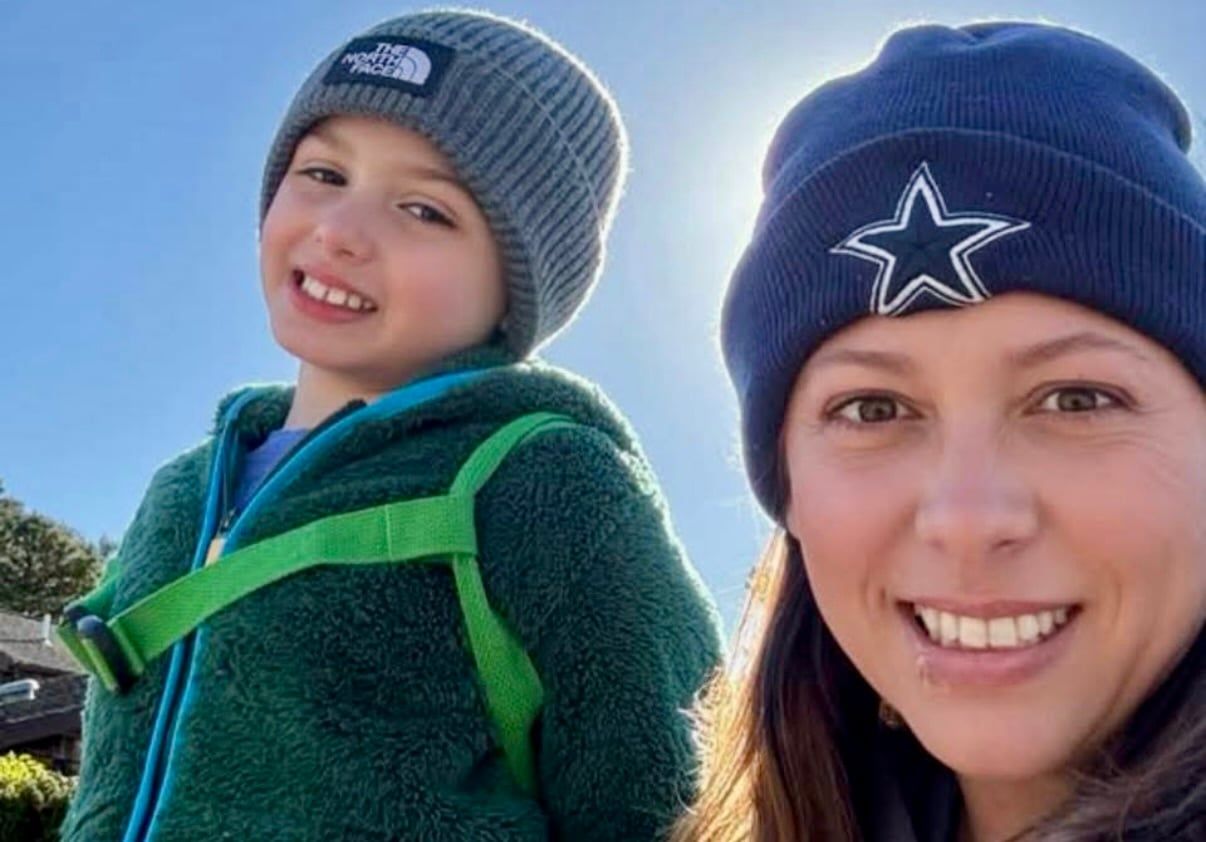
Top: Melissa Aguanno and her son, Jayden, 7. (courtesy photo)