
Click here for Greater Long Island newsletters. Click here to download the iPhone app. Or follow GLI on Apple News!
A conservation success story still unfolding
Merrick is on the turkey map.
A wild turkey report from the South Shore hamlet popped up on eBird this year, a first as far as state wildlife biologist Hunter Hedges can remember. The birds are still most common in central and eastern Long Island, but he’s seeing more reports farther west.
And Long Island has no shortage of what they like.
“They love yards, they love bird feeders,” Hedges said.
Freeport and Baldwin, consider yourselves on gobble watch.
For decades, Long Island was fresh out of turkeys. The native birds disappeared in the late 1800s after forests were cleared for farms and firewood.
In 1993, the state Department of Environmental Conservation brought down 49 wild turkeys from upstate and released them at Hither Hills State Park in Montauk and Southaven County Park in the Town of Brookhaven, Hedges said.
Five years after the first release, a flock at Brookhaven National Laboratory already had a morning routine. The birds would stop for a drink near the water treatment plant, mill around and cross the road into the woods.
The lab’s Thanksgiving-week bulletin headlined a story and turkey flock photo as such:
“Thanksgiving Day Parade.”
From a few dozen to thousands
In 1999, the lab estimated it had 60 to 80 wild turkeys on its grounds. By 2004, it put the number at about 500. A 2012 report gave an estimate of about 300, and in 2022, the lab reported 350 to 500 birds on the property.
Across Long Island, DEC estimated more than 3,000 wild turkeys in 2009, when it proposed the Island’s first fall turkey hunt. A decade later, the agency described the birds as widespread across Suffolk County, with pockets in eastern Nassau, on the North Shore. In 2023, Suffolk held its first spring turkey season.
Hedges described today’s population only as “robust,” but couldn’t provide estimates. The DEC tracks how the birds are doing through spring and fall hunting data and an August survey that gauges breeding success by looking at how many young turkeys, called poults, are seen per hen.
“It’s been a great success story because they are thriving for sure,” he said.
What the birds find farther west
Turkeys do well where patches of woods give them trees to roost in at night and open ground gives them room to scratch for food during the day.
A suburban yard can offer some of the same things.
Some 10 to 15 wild turkeys come around every year and hang out in Hedges’ own front yard.
🦃 Just out for a stroll on Long Island. Once gone from the Island, wild turkeys are turning up farther west. This year, a sighting was reported in Merrick. Here’s how the birds made their comeback. Video: Luke Ormand https://t.co/ORRN7JPKuS https://t.co/xH1up08FKw
— Greater Long Island (@Greater_LI) November 23, 2026
“I love watching them,” he said.
In central Long Island, he said, the number of birds may be much the same as it’s been for a while. And that’s a lot of turkeys.
But in a neighborhood where people rarely see wild turkeys, even a few can draw attention.
“Further west we’re getting more interactions and sightings,” he said. “Even if it’s not a crazy amount more birds.”
Where turkeys fit in
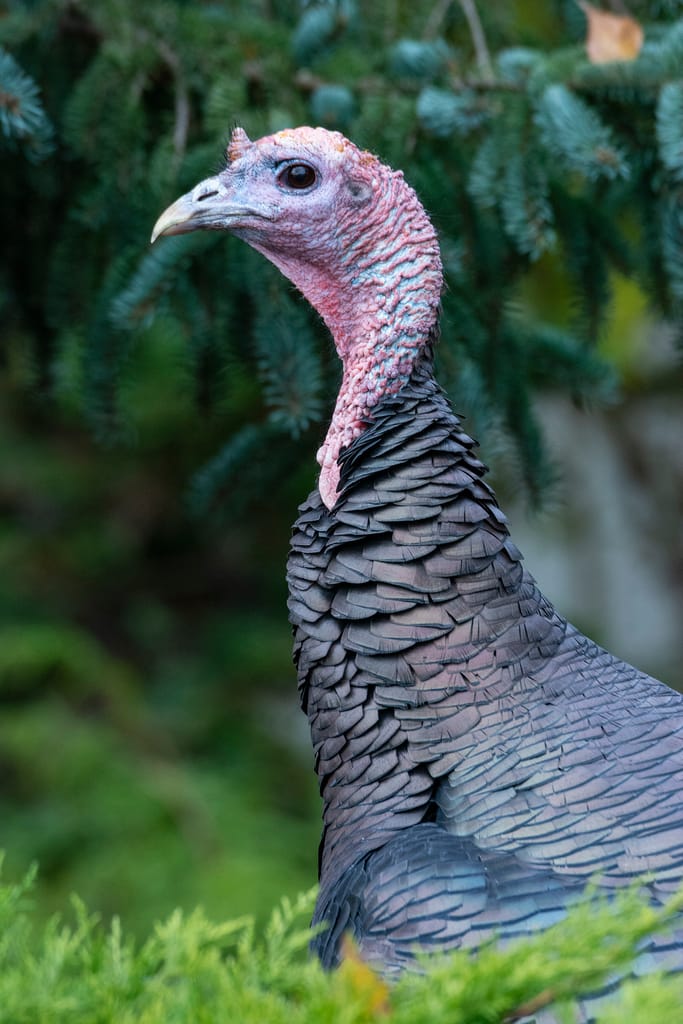
The comeback restored a native species to Long Island’s food web. Watch a turkey feed and you’ll see it rake the ground with its feet, turning up seeds, grains and insects. Turkeys also eat fruit off bushes and will eat ticks they happen upon, Hedges said.
“Whatever they get they’ll be more than happy to eat,” he said. “They’re opportunists.”
The birds are also food for other animals. Hens nest on the ground, where snakes can eat the eggs. Foxes and raccoons eat eggs and can prey on chicks. Adult turkeys have fewer predators, Hedges said.
At dusk, they fly up into trees, often roosting in groups so they can alert one another to any perceived danger.
“Their chicks definitely play a role in that whole circle of life,” he said.
When they show up in your yard
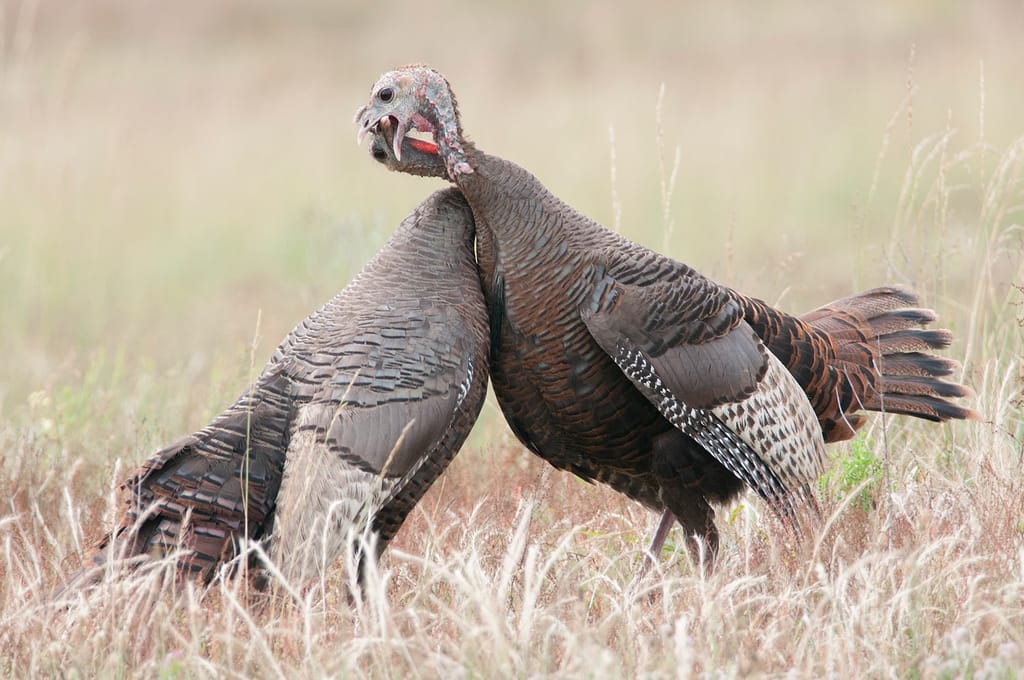
This time of year, Hedges said, you might see “30 birds all hanging out together.” If a flock finds spilled seed under a bird feeder, it may keep coming back. Hedges said people should avoid deliberately feeding wild turkeys so the birds stay wary of humans and don’t learn to look to them for food.
Come mating season, a territorial tom can mistake its reflection in a shiny car door or a sliding glass door for a rival. It may charge and strike the surface, Hedges said.
If a turkey comes toward you and seems aggressive, his advice is simple.
“Just act big, don’t run away,” he said.
And yes, you can eat wild turkey. Hedges hunts them himself. He described turkey hunting as a tradition for many families and a way to fill the freezer. As for how a wild bird compares with what’s at the supermarket, he has a preference.
“I personally feel that wild turkey tastes better than any Butterball or store-bought turkey you’d get.”
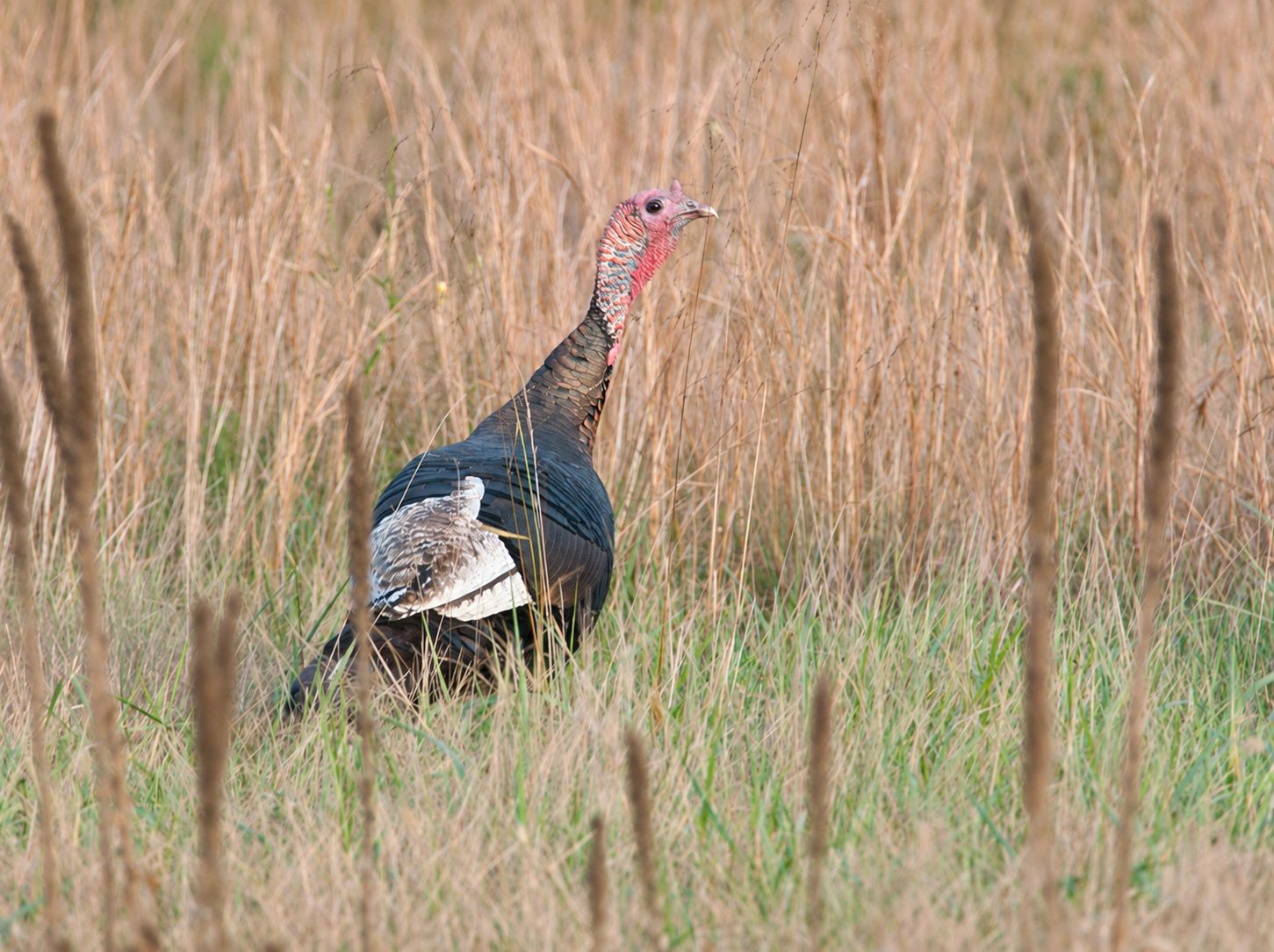
Top: A wild turkey stands amid tall grass on eastern Long Island. (Luke Ormand/courtesy)