

Karen Dasaro lost a $14,000 deposit to install new windows with the now-shuttered Alure Home Improvements.
The Wading River woman’s home improvement project never got off the ground because Commack-based Alure Home Improvements — aka Alure Home Solutions — abruptly shut down in November following the filing of Chapter 7 bankruptcy by its parent company, Renovo Home Partners. The filing came a week after the company accepted Dasaro’s down payment.
Once nationally recognized as an eight-time project builder on ABC’s ‘Extreme Makeover: Home Edition,’ Alure’s sudden shutdown has left hundreds of Long Island customers with unfinished or never-started work and hefty lost deposits.
Renovo Home Partners, as well as many other regional home improvement companies including NEWPRO, Woodbridge Home Solutions and Remodel USA, declared bankruptcy in early November with little notice. Project deposits were lost and renovations were left half-finished.
Like many other customers who had signed contracts and were awaiting contractors to begin or finish scheduled jobs, Dasaro said she was blindsided by the company’s sudden closure.
“Alure never reached out to us to let us know they were filing (for bankruptcy),” she said. “They must have known the day we signed the contract that they were going out of business because we signed on Oct. 25 and they closed all offices and companies on Oct. 28.
“This is fraud. They took our money knowing they were never going to give us any service or new windows,” she added.
In a letter to her credit card company, sent on Nov. 2, Dasaro wrote, “I called the salesman Frank. He answered his personal phone and told me the company laid him off and closed their doors and was going to file Chapter 7. All workers were told to walk off the jobs because they were not getting paid anymore. So many jobs unfinished.”
Prior to the company’s sudden collapse, it had generally good reviews from customers and a strong presence on Long Island, owing largely to its connection to “Extreme Makeover: Home Edition.”
Founded in 1946 as a painting company, Alure specialized in all types of home improvement, from remodeling and repair — including kitchens, baths, windows and siding — to roofing.
At one time, Alure was run by former Huntington Councilman Sal Ferro (R-Commack), who joined the company in 1989 and later became owner. In 2022, Alure was acquired by Renovo Home Partners.
Dasaro updated Greater Long Island that as of early February, she received good news from her credit card company, essentially saying that since they disputed the down payment charges from the beginning, they are no longer responsible.
She also said she filed a complaint with the Suffolk County Department of Consumer Affairs against a licensed representative of Alure and that a hearing had been scheduled.
However, not everyone may be as fortunate as Dasaro in recovering lost deposits.
Pennies on the dollar: What experts say about recovery
Bankruptcy experts are skeptical that Alure’s customer on Long Island and across the New York region will be able to recover much in the way of lost deposits.
Court records indicate Alure is showing current liabilities between $100 million and $500 million against assets of only $1 million to $5 million.
Wilmington, Delaware-based attorney Matthew Harvey, who is representing Alure in its Chapter 7 case, did not respond to Greater Long Island inquiries about the current status of the bankruptcy case.
“I interviewed homeowners with deposits of between $18,000 and $65,000 in kitchen and bath projects, which were left at framing open, wiring open, and permits outstanding,” said Barry Nussbaum, owner of Toronto, Ontario-based Nussbaum Law.
Nussbaum, a member of the New York State Bar Association, said, “The payments tend to go behind the banks, landlords and tax claims when the contractor declares bankruptcy.”
Bankruptcy attorneys add that Alure’s Chapter 7 filing is more about liquidating assets and closing down, rather than allowing the business to reorganize and continue operating.
“In most instances, clients have no right to recover their money in these circumstances absent a contract that afforded them protection or performance bonds. Unfortunately, most homeowners do not require bonding, particularly on smaller improvements under $100,000,” said Shane Lucado, founder and CEO of InPerSuit Inc., a legal tech platform committed to enhancing legal services for consumers.
“As a result, their claims are unsecured and will likely only entitle them to cents on the dollar,” Lucado said. “If a customer writes a $25,000 check as a deposit and the contractor disappears the day after demo, that homeowner may have little to no recourse to recovery of those funds absent the ability to quickly freeze assets or call out a home improvement trust account clause if even one exists.”
Itay Simchi, a real estate investor and founder of Cleveland, Ohio-based Proven House Buyers, agreed.
“Most deposits paid to contractors are unsecured. In bankruptcy, homeowners typically become unsecured creditors, meaning they’re often last in line, if they’re paid at all,” he said. “I’ve seen clients file claims only to recover pennies on the dollar, if anything.”
‘It’s disgusting’: a veteran’s story
Alure’s closure also impacted customers off Long Island, like Stephen Vaughn, a retired veteran in Elmsford, New York, who said he had been “saving for years” to renovate his bathroom.
Vaughn said he lost more than $11,000 on a bathroom remodeling job that never kicked off.
He said he saw an ad for Alure via Facebook, checked the local Better Business Bureau and found that Alure was a legitimate company with a good history.
“I was told I could qualify for a discount,” Vaughn said, “The salesperson told me I needed to give a 30 percent deposit upfront to qualify for the Facebook special that was running. I paid him $11,120 for a down payment.”
Vaughn recalled being told he’d be contacted by a project manager on Oct. 27. When that date came, Vaughn learned the company was filing for bankruptcy.
The upstate man said he tried unsuccessfully to put a stop payment on his check. He believes that the people he dealt with at Alure knew the business was going belly up but took his money anyway.
“When you file bankruptcy, it’s a process. It doesn’t happen overnight,” Vaughn said. “When they came out here, they wanted to get as much money as possible because they knew the company was going bankrupt. It’s disgusting.
“I’m out $11,000,” he said. “We work hard for our money. I have no respect for people who do this kind of thing. I’m a very dissatisfied person and I think people should be aware.”
Vaughn reported that he is now trying to do the work himself after having lost his down payment. He add ed that more than two months have passed and he too hasn’t heard anything about the bankruptcy.
A contractor’s advice: how to avoid the next Alure
Danny Niemela, a professional home remodeler and vice president/CFO at Phoenix, Arizona-based ArDan Construction, a luxury home remodeling company, has some tips for Long Island homeowners to protect their finances when looking to do renovations or remodeling.
Niemela said that “when a contractor files bankruptcy and shuts down without completing a job, collection is a miserable process unless the homeowner was set up in advance before signing.”
He suggested the “best strategy is to pay based on verified milestones (not rough timelines) and never pay more than 10 percent or $1,000 up front, whichever is less.”
“On larger jobs in excess of $25,000, it’s worth paying $300 for a third-party escrow draw structure… It’s money well spent when the problem arises,” Niemela said. ‘Otherwise, most consumers line up behind secured creditors and walk away with nothing.”
Other tips Niemela said are worth considering include finding out if your homeowner’s policy includes fraud or incomplete renovations coverage.
“Not all carriers offer it, but I have seen policies pay $10,000 to $25,000 on theft clauses,” he said.
And to avoid contractor nightmares from happening in the first place, he said that “vetting should be much more than verifying a license number or reading online reviews.”
“I would ask for supplier references; if their drywall or plumbing distributor says they pay late, that is a very, very big red flag,” Niemela warned. “Demand proof of liability and workers’ comp with the homeowner named on the certificate.
“If a company cannot absorb $5,000 in material cost without the money from your pocket first, they are already cash strapped,” he continued. “No reputable builder is after your deposit.”
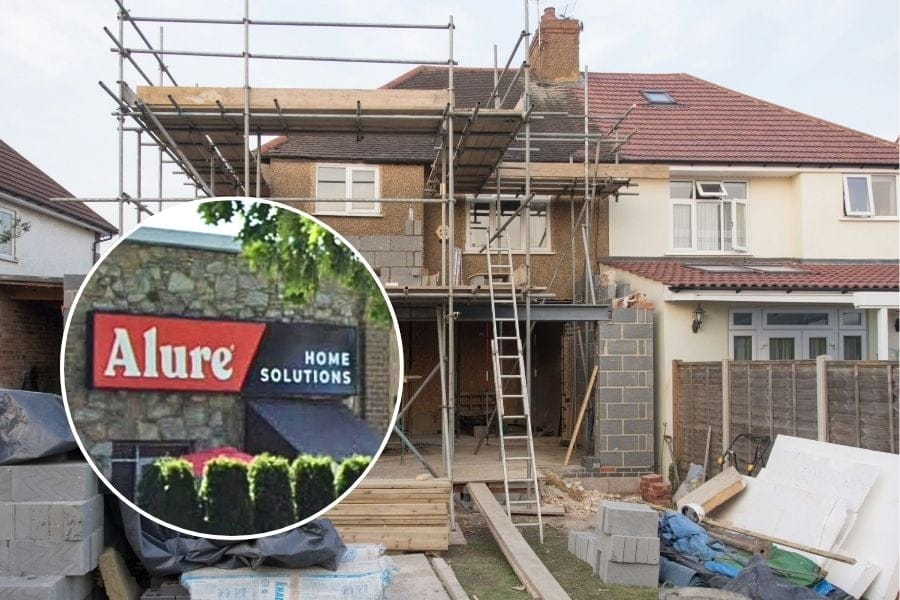
Top: GLI stock photo and Alure’s closed Commack location (inset, via Google Maps Street View)