

Experience the difference at Greater Long Island Dental, your family-oriented general and cosmetic dental practice delivering exceptional quality of care through advanced technology, concierge-level service, flawless results, and a deep respect for every patient’s needs!
In her bombshell complaint, former dancer Christine DeMaria alleges dark and soundproof VIP rooms, patrons walking into locker rooms, and a business model built on assault.
The lawsuit filed against a Gossip Gentleman’s Club and Lounger by an attorney who for years worked as an exotic dancer is a devastating 47-page legal broadside against the Melville strip club.
Christine DeMaria alleges that what masqueraded as a high-end gentleman’s lounge was actually a carefully engineered sex trafficking operation where management “sold off the very safety they had already charged the dancers to provide.”
DeMaria’s lawsuit against Gossip — filed Thursday in New York State Supreme Court and obtained by Greater Long Island — reads like a whistleblower exposé screenplay, complete with soundproofed VIP rooms locked from the outside, managers acting as procurement agents for wealthy clients and a systematic campaign to get dancers drunk and compliant.
What makes DeMaria’s lawsuit particularly compelling is her unique position: she is an attorney who experienced the alleged abuses firsthand.
After leaving Gossip, DeMaria completed her bachelor’s degree at Thomas Edison State University, graduated from New York Law School in June 2024, and passed the New York bar exam over the summer.
She founded SWITCH (Sex Workers in Transition Compassion Home), a nonprofit that helps dancers, sex workers and trafficking survivors transition to new careers. The organization earned her the David Prize from the Walentas Family Foundation — a $200,000 award recognizing visionary New Yorkers creating lasting social change.
DeMaria is also pursuing lawsuits against Manhattan strip clubs where she alleges similar patterns of assault and retaliation, suggesting what she experienced at Gossip wasn’t an isolated case but part of a broader industry problem.
In her complaint against Gossip, its owner Brian Rosenberg, and a number of other defendants associated with the club, DeMaria paints a picture of a business where “women’s bodies are commodities” and safety rules were simply “price tags” that could be negotiated away for the right amount of cash.
“Night after night, staff pressured [DeMaria] to perform sex acts for customers, made clear that sexual access, not lawful performances, was what was really being sold, and punished [DeMaria] when she refused to be turned into a prostitute for the Club’s benefit,” the lawsuit alleges. “Dancers who objected to being coerced into dangerous situations were punished with lost shifts, retaliation, or expulsion.”
Paying for protection that never came
DeMaria says in the lawsuit that she started working at Gossip in November 2016, believing the club’s steep fees and ever-present male staff existed to protect dancers.
Instead, she alleges, she discovered a cruel con: dancers paid $40-$100 nightly “house fees,” plus mandatory tips to DJs, managers, floor workers, and a “house mom” — all supposedly for safety.
“The very people charged with safeguarding the dancers were, in reality, their traffickers,” the complaint states. “They took money from dancers for protection, then took money from high-spending patrons for unfettered sexual access to the dancers.”
The lawsuit describes how managers would intercept cash payments from customers before dancers could touch them — counting out $250 for the dancer while pocketing the rest, regardless of the total amount (as long as it exceeded the $200 room fee).
When customers used credit cards, dancers were required to remain silent while management presented receipts with tip lines — and were “expressly prohibited from explaining that any amount written on that line, regardless of the customer’s intent or the dollar figure, went directly to management, not the dancer,” according to the court documents.
“This practice routinely provoked anger and hostility from customers, who believed the dancer had deliberately misled or ‘conned’ them,” the complaint alleges.
Soundproof, lockable VIP rooms
In January 2022, when DeMaria returned to work following a brief closure of the club for renovations, she discovered two new VIP rooms had been constructed using space from the dancers’ locker room. The placement meant customers had to be “shuttled through the locker room, where female dancers” changed and were often unclothed, the lawsuit states.
There was no other route to access the private “Red” and “White” rooms, DeMaria says in the suit.
A co-worker named “Jessika” warned DeMaria the rooms were “fully soundproofed and locked from the outside,” the lawsuit states.
“If a customer wanted to rape and kill you, they could do it back there,” Jessika reportedly told DeMaria, according to the complaint, while “visibly shaking.”
The lawsuit alleges that just weeks before the renovation, in early January 2022, two dancers — identified only as “Cherry” and another woman — were “brutally raped and assaulted” in a VIP room while “Manager Ava” and “Bouncer Steve” stood posted outside the door.
The complaint says further that “Gossip prevented dancers from calling the police, and the two women who were raped disappeared from the Club.” Rosenberg allegedly fired “Manager Ava” shortly after — not to take responsibility, the lawsuit claims, but “to save face and project a false image of accountability.”
Selling sexual access
DeMaria’s lawsuit details a sophisticated system where managers allegedly acted as brokers between wealthy clients and dancers, with the owner Rosenberg and senior manager Spiro Anastasiadis, also named as a defendant in the lawsuit, at the center of the effort.
The complaint alleges Anastasiadis “ran a concierge pipeline for wealthy and celebrity clients, coordinating fee-based sexual encounters with dancers and skimming the proceeds.”
In one incident detailed in the lawsuit, DeMaria alleges Anastasiadis “opened the door to a private room and forcibly pushed [DeMaria] inside” in April 2022, shortly before the club was to close, approximately 3:45 a.m.
The room was unlit and DeMaria was momentarily disoriented, she said in the suit. When the occupants realized the door had closed, an exotic dancer and defendant in the lawsuit identified as Michele turned on the lights, DeMaria alleges.
DeMaria says she then then witnessed another stripper, a woman identified as “Defendant Alana” in the lawsuit, engaged in oral sex with a man customer, while Michele was talking to another customer in the opposite corner, according to the complaint.
The lawsuit further states that when DeMaria refused to participate, one customer exploded: “For the money I am paying, I want to put my d— in somebody!”
The dancer, Michele, then attempted to excuse DeMaria’s refusal by telling the customer: “She’s new here, she doesn’t know yet,” DeMaria alleges.
Priming the dancers for purchase
The lawsuit alleges Gossip weaponized alcohol to break down the performers’ resistance to sex demands.
“Intoxication increased what Gossip could sell: longer private room time, fewer interruptions, and pliable boundaries,” the complaint states. “Alcohol didn’t protect dancers; it primed them for purchase.”
Management allegedly pressured DeMaria — who doesn’t drink alcohol — to consume drinks and push expensive bottles on customers, even when they were visibly intoxicated. The club offered drink vouchers to dancers each shift “presumably to start getting them drunk early in the night,” according to the lawsuit.
When DeMaria refused to drink, she claims Anastasiadis and Manager Ava “angered” and continued pressuring her.
Line between fantasy and felony disappeared
The lawsuit also levels allegations about special nights when Gossip invited adult film performers to the club.
During one such event, the complaint alleges, a porn star engaged in oral sex on stage. When DeMaria reported the illegal conduct to Manager Ava, expecting intervention, the woman allegedly dismissed the complaint, responded “I love her,” and “brushed past [DeMaria], deliberately ignoring [DeMaria’s] warnings that the conduct was illegal.”
In a separate occurrence detailed in the lawsuit, DeMaria was selected to perform on stage with a dancer named Toni-Ann Lopez (another defendant in the DeMaria’s lawsuit) for a bachelor party customer in 2017 and was paid $50. During that performance, Lopez allegedly “removed the customer’s belt and pants and manually stimulated the customer beneath his underwear while the customer lay on his back on the stage.”
The lawsuit states this occurred “on the center stage of a packed club, in full view of bouncers, managers, and customers, and was captured by security cameras that were continuously monitored by club employees.”
When DeMaria refused to participate in the illegal conduct, she was “never again invited to participate in these paid stage performances,” according to the complaint.
Fired and blacklisted
After repeatedly reporting illegal conduct to management, DeMaria alleges she became a target.
The breaking point came in late April or early May 2022, when DeMaria was changing in a designated locker area while Lopez — described in the lawsuit as having “supervisory authority” over dancers — was simultaneously live-streaming on social media from inside the club, “during which she described multiple instances of leaving Gossip to have sex with female customers,” according to the complaint.
When Lopez became “visibly irate” that DeMaria was “in her space,” Anastasiadis allegedly erupted, screaming at DeMaria and ordering her to move her belongings to a different locker on the opposite side of the locker room — even though manager Jeanie had specifically authorized DeMaria to use that area for safety reasons after an earlier incident when a customer entered the locker room and filmed DeMaria while she was unclothed, according to the lawsuit.
DeMaria continues in her complaint that days later she was falsely accused of stealing $40 from another dancer during a session they worked together in the Rouge Room, a semi-private lap dance area, while a “Bouncer Larry” monitored the room. Both the accusing dancer’s own client and Bouncer Larry immediately contradicted the allegation, according to court documents.
Despite the on-the-spot exoneration, Anastasiadis called DeMaria on May 28, 2022, and abruptly told her she was fired, refusing to provide any explanation, she sys in the lawsuit.
But the retaliation didn’t end there, she says in her claim. When DeMaria applied to work at two other clubs — Mirage Gentlemen’s Lounge in Farmingdale and FlashDancers in Manhattan — she was mysteriously barred from both “without explanation,” she alleges.
“Upon information and belief, Gossip, through its owners, managers, and agents, defamed and blacklisted [DeMaria] in the industry,” the complaint says.
Eight causes of action
DeMaria’s lawsuit includes the following causes of action:
- Gender discrimination and sexual harassment under New York State Human Rights Law.
- Retaliation for complaining about the harassment.
- Sex trafficking violations under the federal Trafficking Victims Protection Reauthorization Act.
- Fraudulent inducement for lying about safety and working conditions.
- Employee misclassification.
- Unlawful wage deductions and gratuity theft.
- Aiding and abetting discrimination and retaliation.
- Whistleblower retaliation.
The complaint seeks compensatory damages, punitive damages, lost wages, injunctive relief to shut down Gossip’s business model, attorneys’ fees and a jury trial.
Rosenberg and Anastasiadis have not responded to requests for comment. Rosenberg indicated via a text message on Monday that his attorney would provide a statement on Tuesday. Greater Long Island will update this story when the statement is received.
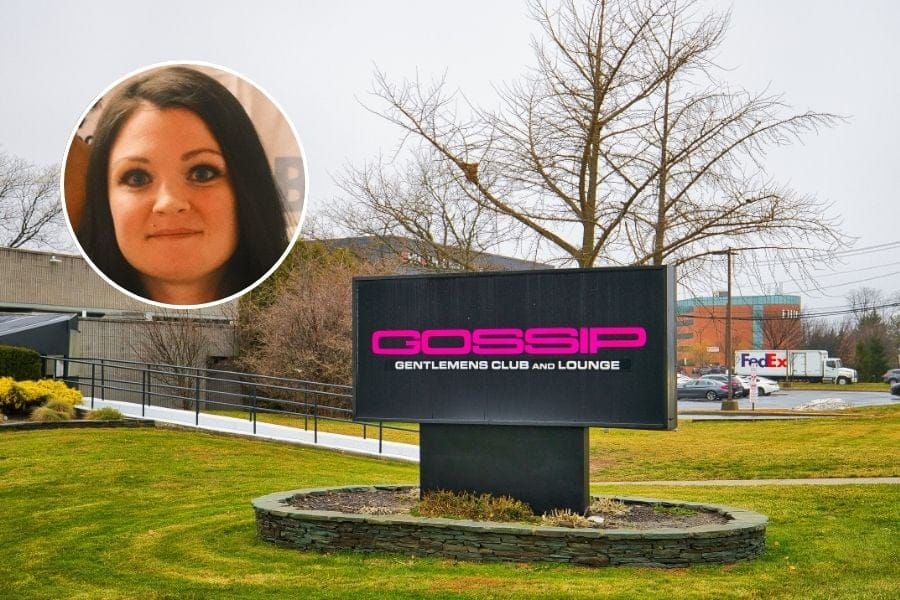
Top: (inset) Christine DeMaria (Instagram) and Gossip Gentlemen’s Club and Lounge (Eric Micallef photo).