The law targets unregulated, profit-driven breeding operations
Limiting dogs and cats to one litter per year.
Creating a public registry of litters.
Imposing fines for violations.
The Hempstead Town Board on Tuesday unanimously approved a new local law aimed at curbing unlicensed “backyard breeding” of dogs and cats, establishing new oversight and enforcement measures within the town.
The measure creates Chapter 153 of the Town Code, titled the Cat and Dog Litter Registry, and is designed to regulate the production and transfer of dogs and cats to protect animal welfare and reduce overpopulation.
“The Hempstead Town Board and I are proud to advance meaningful legislation that protects animals who cannot speak for themselves,” said town Supervisor John Ferretti. “The way we treat animals reflects our values as a community, and this measure addresses a root cause of shelter overcrowding and preventable suffering.
“It’s a compassionate, responsible step toward ensuring the safety, dignity, and well-being of animals throughout our town.”
Under the new law, owners of a female dog or cat may not permit more than one litter in any 12-month period. It is also unlawful to breed a dog or cat under 1 year old or to transfer ownership of a puppy or kitten before 8 weeks of age, unless a veterinarian recommends earlier separation for health or safety reasons.
In addition, any owner whose dog or cat produces a litter must notify the town within 30 days of birth. The town will maintain a registry available to the public, though owner addresses will not be published without written consent.
Breeders will also be required to maintain medical records, transfer records and identifying information for each animal produced, with records kept for at least 12 months.
Violations carry fines of up to $250 for a first offense and up to $500 for subsequent violations.
The law will take effect 180 days after adoption, the resolution reads.
When Ferretti first announced the proposal Friday at the Town of Hempstead Animal Shelter, he framed it as a measure focused on responsibility and animal welfare.
“This proposal is about responsibility and accountability,” Ferretti had said. “We want to ensure that animals in our community are bred safely and humanely, and that we are doing everything we can to prevent neglect and overpopulation.”
The law is written and designed specifically to target unregulated, profit-driven and high-volume breeding operations that can lead to overcrowded conditions and health problems for animals, town officials said.
Editor’s note: This report was updated post-publication with a quote from the supervisor.
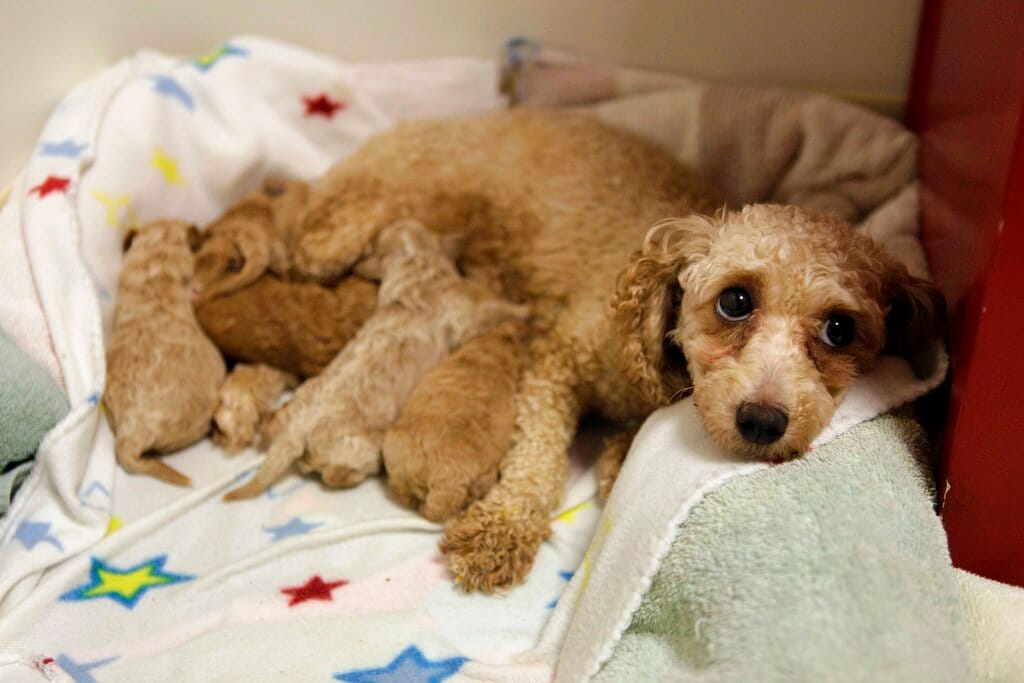
Top: In this Nov. 11, 2009 photo, a recently acquired poodle curls up in a warm corner with her new litter of puppies at Main Line Animal Rescue in Chester Springs, Pa. (AP Photo/Carolyn Kaster)

Your Long Island news, delivered.
Subscribe to the GLI Newsletter — its free