
Long Island’s crusade against timber rattlesnakes was unorganized, unsubsidized, and unrelenting.
Rattlesnake Brook. Rattlesnake Creek. Rattlesnake Swamp.
You’ve likely passed such sign markers in Oakdale, Sag Harbor or Yaphank, probably zipping by in a car without paying much thought.
But each sign marks the ghost of something that had indeed slithered, hissed and rattled across local forests.
Long Island was once home to a thriving population of timber rattlesnakes — venomous predators that ruled the woods from Brooklyn to the Hamptons.
Today, not one remains. Here’s how it happened.
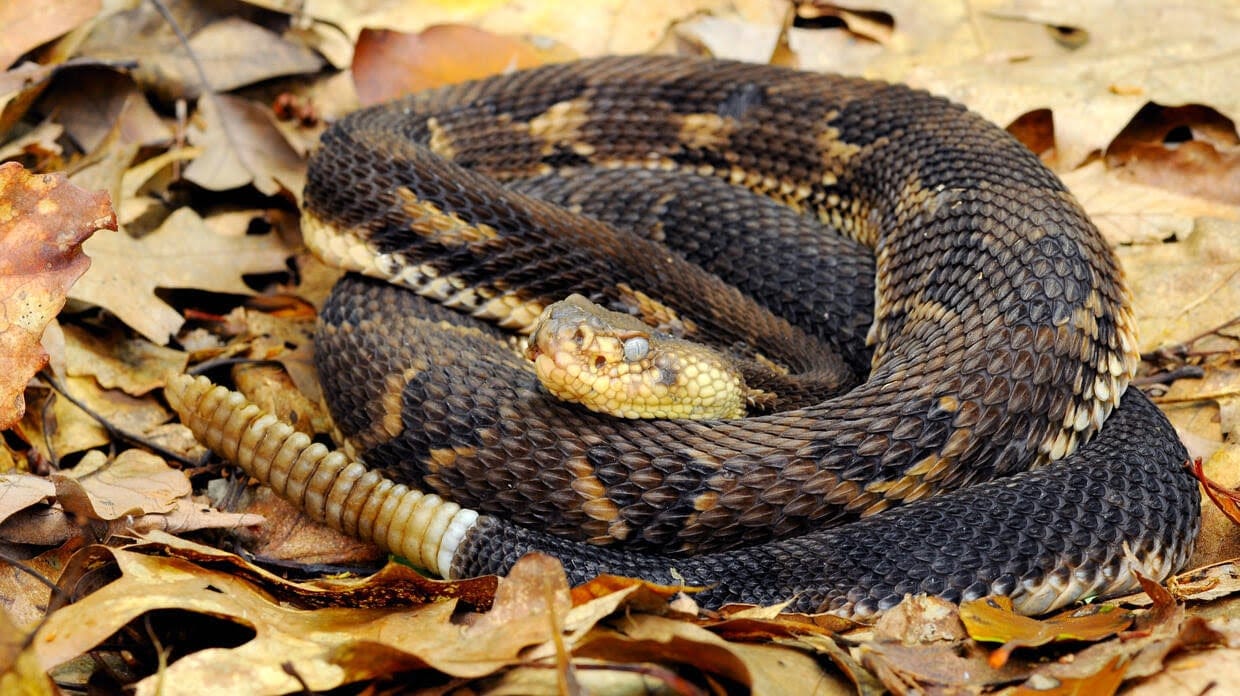
All photos courtesy of Mass.gov
King of the woods
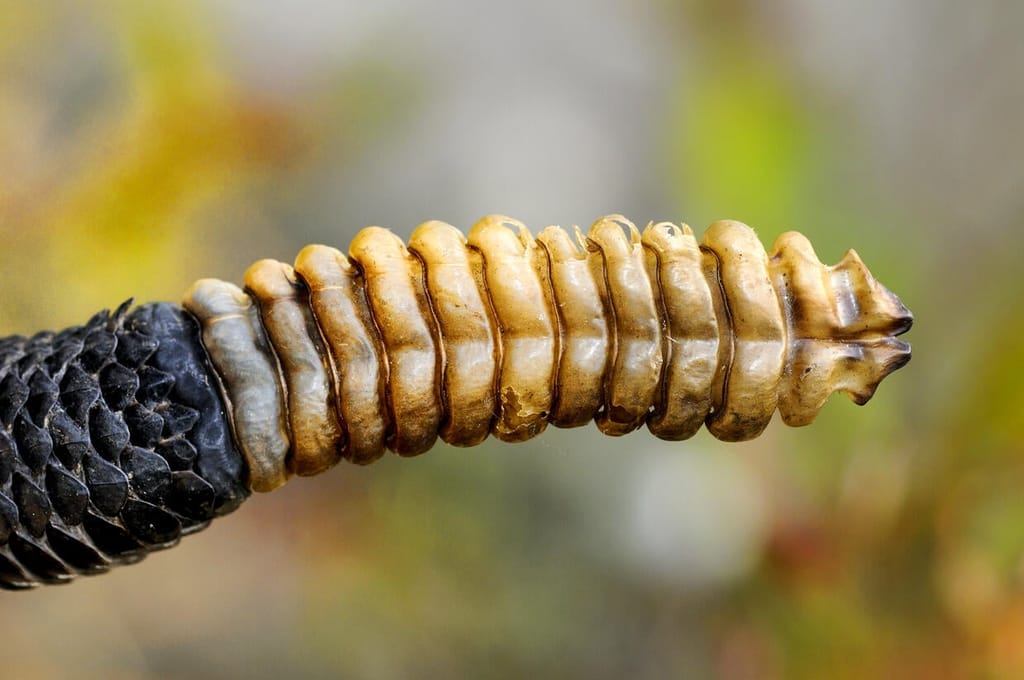
The timber rattlesnake is now listed as “threatened” in New York state.
It’s a striking creature that grows up to five feet long, and patterned in dark chevrons that ripple like tree shadows.
Its tail ends in a stack of hollow keratin segments that clatter together when shaken, producing the dry buzz that once sent shivers through Long Island hikers and bikers.
The rattlesnakes that once lived here fed mostly on chipmunks, mice, voles, small birds and amphibians. Their venom, used primarily to immobilize prey, could be deadly to humans if untreated.
Though dangerous if provoked, they are generally secretive, spending much of their lives basking on sun-warmed rocks or tucked away in dens along forested hillsides.
Their active season runs from late April through mid-October.
In upstate New York, dens typically form in rocky crevices or root tunnels that face south or west — the kind of rugged, wooded terrain that once blanketed much of Long Island, where the snakes flourished. Until they were gone.
How they got here
According to herpetologist and author Ted Levin, timber rattlesnakes survived the last Ice Age in the warmer coastal lowlands of the Southeast. As the glaciers retreated and sea levels rose 6,000 or 7,000 years ago, they migrated north — eventually reaching Long Island with habitats stretching as far north as Maine in the U.S.
They thrived here for millennia, adapting to the Island’s pine barrens and wet lowlands.
Levin says they were common from Brooklyn, up to Great Neck, out to Bayport, Yaphank and Sag Harbor. Early settlers and Native peoples alike were well aware of them; their names live on in the local streams and hills.
“When Henry Hudson first sailed into New York Harbor in the 1600s, rattlesnakes had free rein of Manhattan, Brooklyn, Queens, and Long Island.” stated Levin, author of America’s Snake: The Rise and Fall of the Timber Rattlesnake.
His quotes are taken, with permission, from this hour-long YouTube video that was published seven years ago.
The end begins
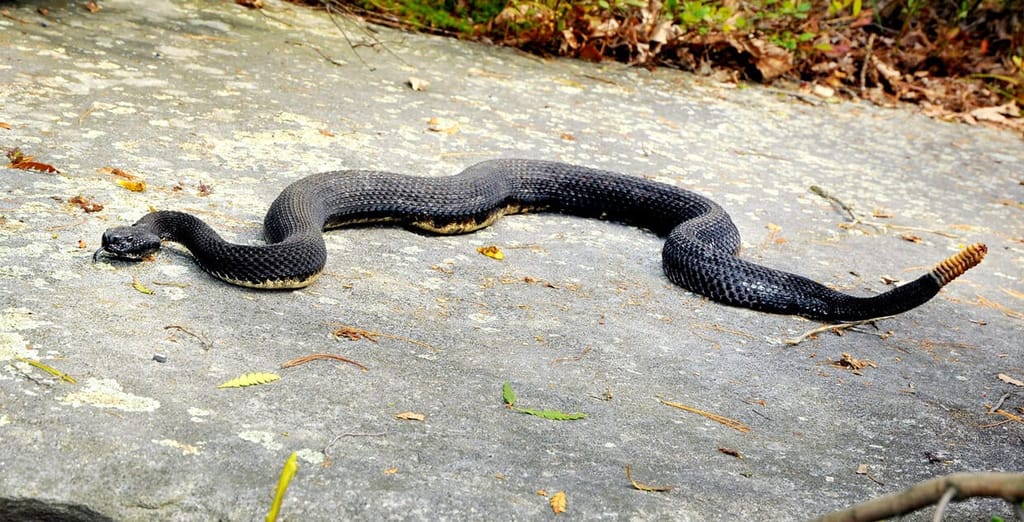
By the mid-1800s, Long Island’s rattlesnakes had become both feared and hunted.
Members of the old South Side Sportsman’s Club — now part of Connetquot River State Park Preserve — appeared to pay bounties on dead rattlesnakes.
“In the 1880s, Edward Knapp Jr. wrote that it wasn’t uncommon to see ten or a dozen snake skins stretched out on boards drying in the sun,” Levin said.
Local newspapers chronicled the killings with frontier-style excitement. The South Side Signal, an influential Babylon-based weekly newspaper, reported a rattlesnake beheaded by a train in Yaphank in 1882, and another slain by a track worker in Center Islip.
Even cyclists got in on it — one Oakdale rider proudly displayed a tail to the community.
“On Sept. 2, 1898 the Suffolk County News mentioned that an Oakdale cyclist slew a rattlesnake and then retained a highly prized relic — the snake’s tail, which was ornamented with eight rattles and a button,” Levin said.
At the Sportsman’s Club, caretaker Thomas Riley kept a logbook of his kills: one snake with five rattles one day, another nearly five feet long the next. Each entry marked the slow extermination of a native species.
Gone from the Island
Long Island’s crusade against timber rattlesnakes was unorganized, unsubsidized, and unrelenting, Levin said.
And by the 1950s, suburban sprawl had devoured the last wild corners of the South Shore especially. When Levin moved to Long Island in 1952, he found a landscape filled with houses and only scattered woods. In the early 50s, he said, the few rattlesnakes that existed on the Island were sequestered in Oakdale, Yaphank and East Moriches.
Then, in 1962, a single snake was spotted — and killed — in East Moriches. No one has seen one since.
The timber rattlesnake was officially extirpated from Long Island.
Could they return?
Levin believes reintroduction is biologically possible, but it would rely on human intervention. And that would socially and politically complicated.
“Snake phobia is present in about 40 percent of humans,” he said. “That makes bringing them back a tough sell.”
Today, timber rattlesnakes survive only in small, isolated, and semi-isolated populations in mountainous areas in southeastern New York, the Southern Tier, and in edges of the easternmost Catskills and Adirondacks. They remain protected under state law. It is illegal to approach, touch, move, threaten, harass, disturb, injure or kill a timber rattlesnake
The state Department of Environmental Conservation advises anyone who encounters one to simply step back and let it pass.
“Timber rattlesnakes are not aggressive unless provoked,” the agency notes. “Keep at least six feet away.”
But if that were to happen, you’d be far from Long Island.
Their hiss and rattle are long gone now, replaced by the sounds of traffic and leaf blowers.