

Think you spotted a gecko in your garden? Chances are, it’s one of Long Island’s growing crew of Italian wall lizards.
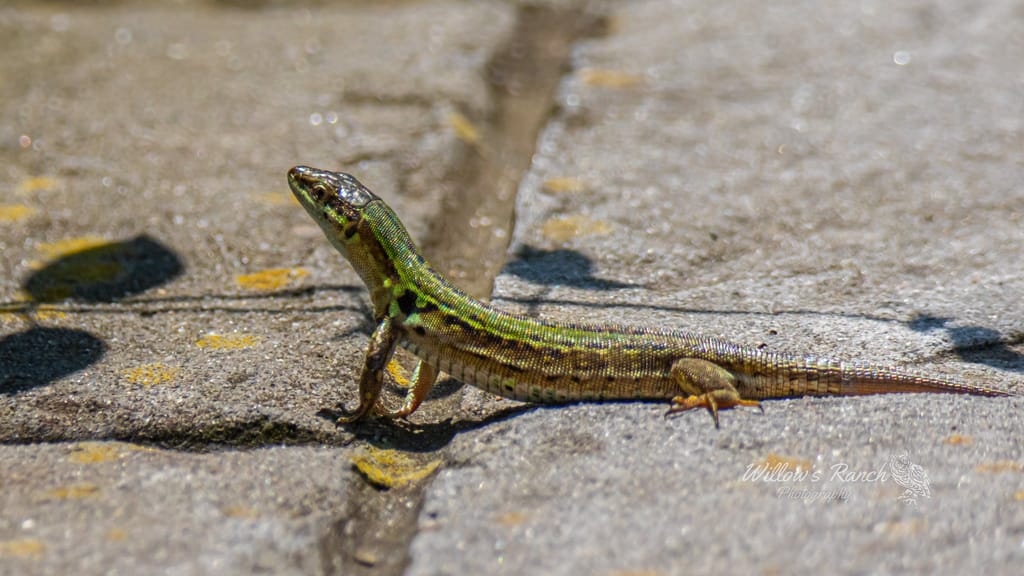
It started with a few escapees in Garden City. Now, the 6-inch green lizards — flecked with brown, yellow and tan — are thriving across Long Island, with experts saying their population is steadily expanding east.
“I certainly hear from people who didn’t used to see lizards, but now that they’re in their neighborhood, they’re just delighted to have them there,” said Russell Burke, associate professor in Hofstra’s department of biology.
For more than 60 years, these warm-weather lizards have been crawling their way through Nassau and Suffolk counties, with the past decade seeing a noticeable uptick in sightings.
In Central Suffolk, according to readers, scores of lizards started appearing in large numbers in the Centereach and Selden areas this spring.
And they’re not just multiplying on their own — humans are helping them settle in.
Top photo: An Italian wall lizard in W. Hempstead. Credit: Mike Shapiro/Mike 55 Photography
How they got here
The Italian wall lizard made its way to the U.S. in the 1960s and ’70s when animal dealers imported the reptiles from Italy to sell as pets. In 1966, a group of them escaped from a Garden City pet store, laying the groundwork for a decades-long reptilian residency on Long Island.
Although these lizards are more common in warmer, tropical climates, the species found here — podarcis sicula and podarcis muralis — are native to cities in northern Italy, such as Florence. They’re hardy enough to withstand Long Island’s winters by burrowing deep underground from November through February.
Even though they grow more slowly here than in Italy, reproduce less often, and mature at a slower rate, their numbers have still increased significantly.
Burke said people also play a big role in their spread.
“A lot of people like having these lizards and they’re kinda like birds at your feeder — it’s cool to see them feeding and interacting with stuff,” he said. “People enjoy catching the lizards and creating a home for them in their backyard.”
The reptiles have also traveled naturally along Long Island Rail Road corridors and — unintentionally — via mulch.
Burke noted that some people may unknowingly bring lizard eggs home in bags of mulch, especially from facilities near where the original escape occurred.
“Right near the spot in Garden City where the pet shop used to be, I know there’s a mulching facility and it’s very easy to imagine that taking some of that mulch home, you’ve brought some lizard eggs,” he said.
Harmless, even helpful
Despite their rapid expansion, these lizards aren’t considered a threat to the environment — or to your backyard.
Burke said they’re harmless and might even be beneficial, since they eat a variety of insects and other small pests. And because most of the insects and spiders they feed on aren’t native either, they likely aren’t disturbing the local ecosystem too much.
“They live in urban environments where pretty much everything is not native to begin with,” Burke said.
Getting rid of them, however, isn’t easy.
Even if someone were to remove every single lizard from their yard, Burke said, the population could easily rebound within a week.
They’re here to stay — and may actually be a good introduction to nature for future scientists.
In a 2005 paper titled “Italian Immigrants” Flourish on Long Island, Burke pointed out the educational value of having wall lizards in residential neighborhoods.
“For me, the opportunities to watch and handle wild animals in my neighborhood played a key role in my inclination to become a biologist,” he wrote. “Wall lizards can provide the herpetological equivalent of watching birds at feeders, introducing students and other nonprofessionals to the basics of scientific research.”
Since becoming a professor, Burke said he’s personally watched the population grow from Hofstra’s western campus, to the eastern side.
And chances are, if you haven’t seen one of these little green guys in your backyard, you will soon.
Want to see some?
Look no further than Norman J. Levy Park & Preserve at 1600 Merrick Road in Merrick.
You’ll see them on any warm weather stroll.
More wildlife

Your Long Island news, delivered.
Subscribe to the GLI Newsletter — its free