

Greater Long Island coverage is funded in part by Toresco & Simonelli, a boutique injury and family law firm in West Islip. They fight for their clients. Click here to get in touch.
A dying teenager’s accusation in 1658 sent a Long Island woman to court, where her life hung in the balance.
Long before Salem, East Hampton had a witchcraft case of its own.
A teenage mother fell ill, accused a neighbor of tormenting her through witchcraft and died shortly afterward. Soon, residents were sharing stories of other deaths and misfortunes they believed that same woman had caused.
For Elizabeth “Goody” Garlick, those accusations carried the threat of execution.
The case unfolded in 1658, more than three decades before the Salem witch trials, and sent Garlick from her small Long Island community to a courtroom in Hartford, Conn.
For environmental historian Tara Ryder, a senior lecturer in Stony Brook University’s School of Marine and Atmospheric Sciences, the story offers a glimpse into a community where religious beliefs, neighborhood disputes and unexplained illnesses could become a dangerous mix.
Ryder first encountered Garlick’s story while working at the East Hampton Historical Society and reading the town’s historical records. She later brought the case into her classroom to explore the beliefs and relationships that shaped colonial life.
Everyone knew everyone
Founded in 1648, East Hampton was barely a decade old when the accusations began.
“It’s a small village where everyone knows everybody,” Ryder said.
That familiarity meant a person’s history could be hard to escape.
According to Ryder, Garlick arrived in the colonies as an indentured servant and worked on what is now Gardiner’s Island, then called the Isle of Wight. After completing her contract, she married Joshua Garlick and started a family.
Her circumstances had changed, but her neighbors would have remembered where she started.
“She is probably still somewhat of that outsider in this community,” Ryder said. “And everyone would have known she’d been an indentured servant.”
Another woman whose stories figured prominently in the case, Goody Davis, had apparently once been better off before falling on hard times. To Ryder, those shifting fortunes raise questions about the tensions behind the accusations.
“Is this really about religious beliefs and witchcraft or is this more about pecking order?” she said.
Still, Ryder cautioned against reducing the case to a neighborhood grudge. For colonial residents, witchcraft was a real threat.
“The thing to keep in mind is that people did believe in witches,” she said.
A death and accusation
The case centered on Elizabeth Gardiner Howell, the 16-year-old daughter of Lion Gardiner, a prominent figure in East Hampton’s early history.
Howell had recently given birth when she became ill and accused Garlick of tormenting her through witchcraft. She died shortly afterward.
Other allegations followed, involving the death of Davis’s child and the loss or injury of farm animals.
Much of the surviving testimony involving Davis traced back to stories she had reportedly told about her child’s death, Ryder said. Witness Richard Stratton recalled Davis saying she could think of no one on Gardiner’s Island who might have bewitched her child except Garlick.
But Davis herself did not testify.
“The main accuser never actually testifies herself,” Ryder said. “It’s all hearsay.”
Howell had named Garlick directly. Other witnesses repeated accounts they had heard from Davis, bringing the community’s circulating suspicions into the proceedings.
Garlick was in her 50s, Ryder said, facing accusations from neighbors who understood illness and death very differently from how people do today.
“For them, evil was not an abstract idea,” Ryder said. “It was something very tangible.”
East Hampton to Hartford
Over about three weeks, 13 people testified in the local proceedings before the case was referred to a higher court.
East Hampton was then under Connecticut’s jurisdiction. In May 1658, Garlick stood trial in Hartford before a court headed by Connecticut Gov. John Winthrop Jr.
She was found not guilty.
The testimony suggests that even within Howell’s family, witchcraft was not necessarily accepted as the explanation for every tragedy.
Lion Gardiner did not testify directly, Ryder said. Instead, a neighbor recounted a conversation in which Gardiner reportedly suggested that Davis’s decisions about caring for her child, rather than witchcraft, had contributed to the child’s death.
The secondhand account offers only a limited view of Gardiner’s position. But it shows that the surviving record contains more than accusations against Garlick.
Those accusations, however, had already been enough to put her life at risk.
“The fact that there had been the accusation was simply enough to get the trial,” Ryder said.
After the acquittal
Garlick returned to East Hampton, where her family continued to live.
What her neighbors thought of her afterward, and exactly what motivated the accusations, remain unanswered questions.
Her husband later brought a defamation action against Davis, accusing her of damaging his wife’s reputation. According to Ryder, the surviving record does not establish the outcome. Davis died not long afterward.
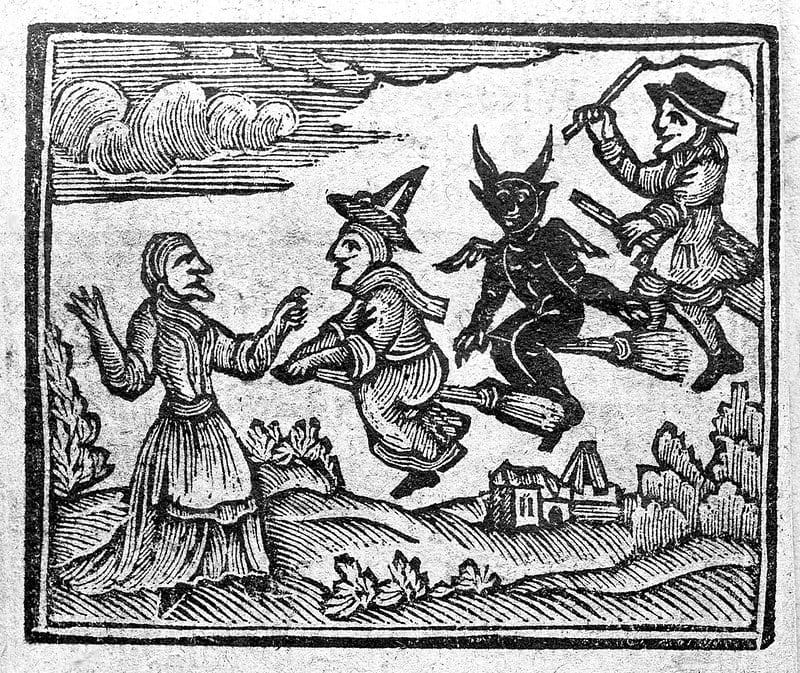
Top: Illustration from The History of Witches and Wizards (1720). (Credit: Wellcome Collection, public domain)

Your Long Island news, delivered.
Subscribe to the GLI Newsletter — its free