

Greater Huntington coverage is funded in part by The Farm Italy, a striking neighborhood restaurant and cocktail bar bringing the simplicity, beauty and seasonal freshness of Italian dining to Huntington.
An American mink has been captured on camera in Northport, giving Long Island wildlife researchers something they have spent decades searching for: unmistakable evidence that the elusive species is still here.
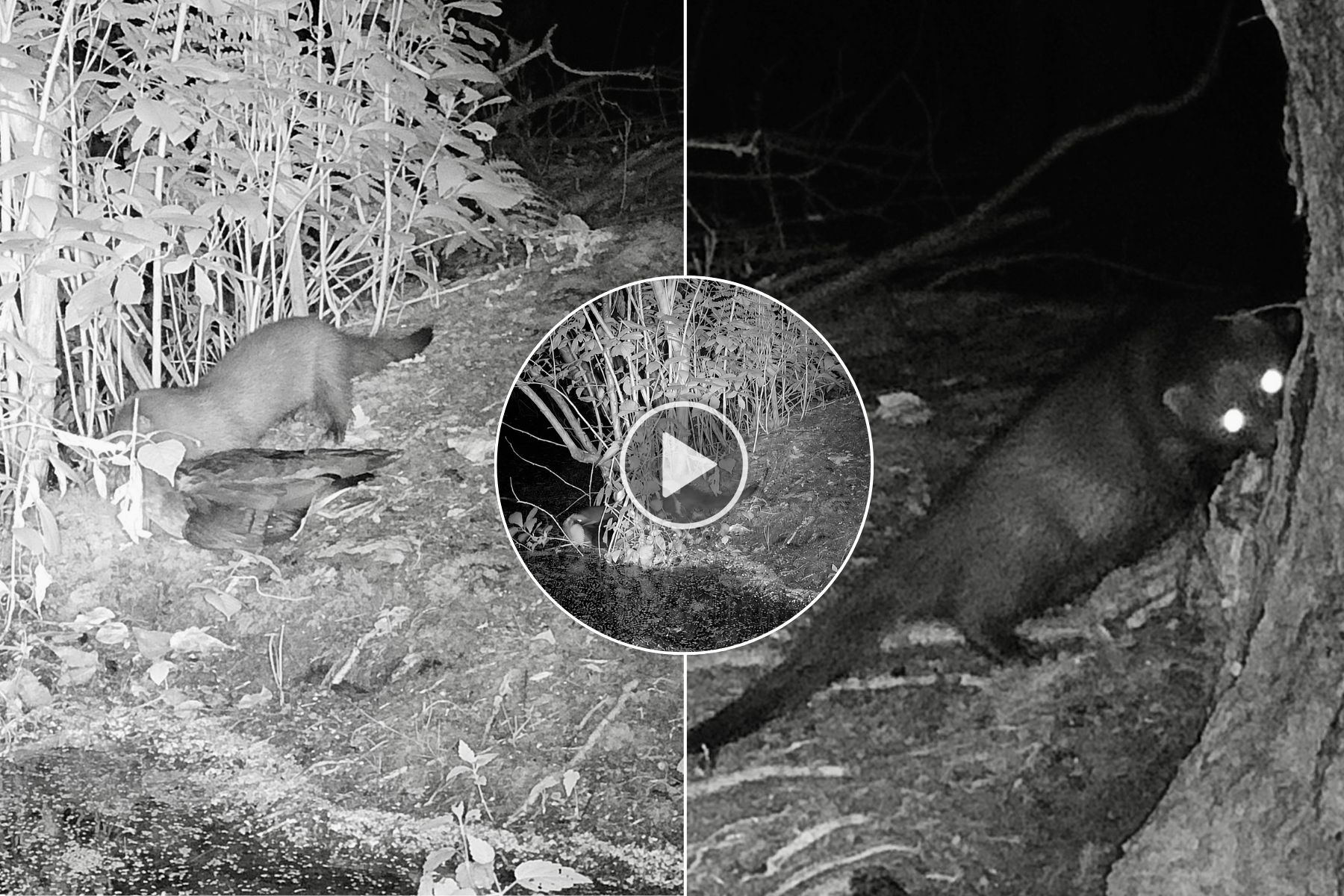
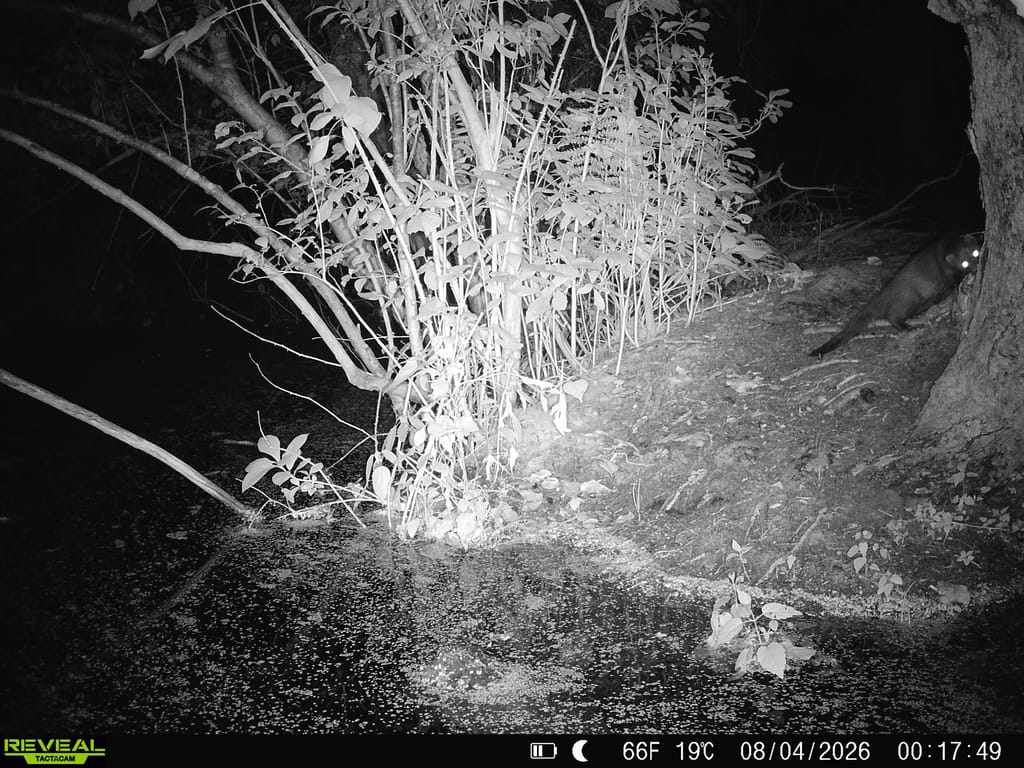
The remarkably clear photographs and video of the mink were captured by local naturalist Peter Janow on a trail camera in the Fuchs Pond complex.
Just how rare is the documentation?
According to Seatuck Environmental Association wildlife biologist Mike Bottini, the animal was last spotted (no photographic evidence) in 1996, and it’s certainly the only photographic record of a mink on Long Island dating back to when the iNaturalist wildlife database websiite first went online in 2008.
For Bottini, who launched the ambitious Long Island Mammal Survey in 2022, along with a team of researchers still at work every day, the elusive mink had remained just that.
“So, yes … I was losing faith,” Bottini told Greater Long Island.
Go back six decades, however, and the story was dramatically different. The last comprehensive mammal survey of Long Island, conducted by biologist Paul Connor in the early 1960s, found mink and signs of mink well distributed throughout estuaries and tidal creeks along both the North and South shores, as well as along the Peconic River, Bottini said.
Today, researchers are struggling to find them at all.

Bottini and Seatuck launched the Long Island Mammal Survey to document the current status and distribution of the Island’s terrestrial and semi-aquatic mammals, including mink, river otters and muskrats.
But Bottini’s search for mink began much earlier. From 1989 through 1999, while working for the Group for the South Fork in Bridgehampton, Bottini said he would head to the Long Pond Greenbelt whenever local ponds froze. And even a dusting of snow provided an opportunity to search for tracks.
Bottini had been trained by a retired professional trapper in New Hampshire to identify tracks left by mammals including mink, river otters, coyotes and bobcats.
Despite what he described as excellent mink habitat in the Long Pond Greenbelt, he never found a sign of one.
Neither have many of Long Island’s veteran naturalists.
“Most of my naturalist colleagues have never seen mink here,” Bottini said.
There have been exceptions.
Naturalist, photographer and author Rob Villani encountered an adult mink, likely a female, with young at Shu Swamp in 1996, Bottini said, providing evidence that mink were successfully breeding on Long Island at the time.
“That’s a long time ago,” Bottini said.
The absence became increasingly conspicuous as researchers deployed technology that should have made mink easier to document.
Bottini said colleagues studying river otters elsewhere in North America routinely capture trail-camera images of mink visiting otter latrine sites.
Yet when Bottini conducted a yearlong trail-camera study of river otter behavior at 10 such sites on Long Island in 2013, the cameras did not capture a single mink.
Researchers knew some other native mammals were in trouble. Bottini said it was already considered likely that the gray fox had been extirpated from Long Island, while striped skunks and long-tailed weasels appeared to be extremely rare.
The Long Island Mammal Survey has since found evidence that the latter two are hanging on in the Central Pine Barrens, he said.
Mink were different.
“The mink situation is a shock,” Bottini said.
‘There it was’
The American mink surveilled at Fuchs Pond complex dragging prey, in this case a bird, into water. (Credit: Peter Janow/Long Island Nature Corps)
Janow, a native Long Islander, retired Marine Corps pilot and founder of Long Island Nature Corps, has spent roughly eight years deploying trail cameras and documenting wildlife across the Northport and Greater Huntington area.
Much of his work has centered on the Crab Meadow watershed, the Fuchs Pond complex and the Henry Ingraham Nature Preserve, an area Janow calls an “absolute, absolute wildlife gem on Long Island.”
About three winters ago, Janow was searching for river otter tracks after a fresh snowfall when he came across tracks he believed belonged to a mink.
“I thought it was just a matter of time before I captured a mink on one of my trail cameras,” he told Greater Long Island.
It took a few years.
Earlier this month, Janow pulled a memory card from a camera he hadn’t checked in months. While watching golf at home, he spent roughly two to three hours going through the files one by one.
Eventually, two photographs and a roughly 15-second video appeared on his screen.
An American mink.
“Lo and behold, I found the two pictures and one short, 15-second video of an American mink in the Fuchs Pond complex,” Janow said.
One photograph shows the animal alongside a tree, providing a particularly clear look at its body and face. Another captures the mink dragging a bird into water.
Janow immediately sent the images to Bottini.
“He came back quickly and said, ‘Hey, yeah, that’s 100 percent an American mink,’” Janow recalled.
Janow also uploaded the observation to iNaturalist, where several fellow nature lovers confirmed the sighting.
“Kudos to Peter Janow,” Bottini said. “At this point in time he has the only record of a mink on L.I. going back to when iNat was first online.”
Bottini also credited Janow’s trail-camera work and snow tracking with providing significant assistance to the Long Island River Otter Project.
What happened to the mink?
Confirming that at least one mink remains on Long Island solves one mystery.
It leaves a considerably larger one unanswered.
“What happened?” Bottini said.
Unlike species whose habitat has largely disappeared, Bottini noted that much of the mink’s preferred habitat, including wetlands and salt marshes, still exists on Long Island and is protected.
Road mortality could be one factor, he said, although Long Island’s recovering river otter population demonstrates that vehicle strikes do not necessarily prevent a species from expanding its range.
Another possibility researchers may need to consider is rodenticide exposure.
Unlike river otters, whose diets consist overwhelmingly of fish and crustaceans, Bottini explained, mink also prey on terrestrial animals such as mice, rats and voles, potentially exposing them to poisons that move through the food chain.
Bottini said he encountered evidence of that danger two years ago when a dead bald eagle found beneath its nest in Montauk was determined to have died from anticoagulant rat poison.
He stressed, however, that the reason for the mink’s apparent decline remains unknown.
Trapping presents another complicated question.
The state Department of Environmental Conservation currently permits trapping of mink, gray fox, striped skunk and long-tailed weasel on Long Island, Bottini said.
In 2011, Bottini and fellow naturalists John Turner and Tim Green petitioned the DEC to prohibit trapping of those species on Long Island. The request was denied, he said, and the state subsequently initiated a Long Island furbearer survey.
Bottini argues that the resulting population data do not justify continuing to allow trapping of the four species.
But he is equally clear about what the available evidence cannot establish.
“We can’t say that trapping is the cause of the decline of these species,” Bottini said.
That leaves researchers with a remarkable contrast: mink were sufficiently widespread in Long Island waterways as soon as six decades ago, and now they’re so rare that Janow’s photos and video might be the only photograph evidence of their existence here — outside of the remote Fishers Island.
For Janow, that’s exactly why documenting Long Island’s wildlife matters.
“When we are aware of what species are here, and their numbers, and the threats to their existence,” he said, policymakers can make “better-informed, conscious decisions on how we could help out.”
Top: Trail-camera photos and video captured by Peter Janow show an American mink in Northport’s Fuchs Pond complex in August 2026. (Courtesy Peter Janow/Long Island Nature Corps)

Your Long Island news, delivered.
Subscribe to the GLI Newsletter — its free