
Greater Massapequa coverage is funded in part by Greater Long Island Dental, a family-oriented general and cosmetic dental practice offering advanced technology and personalized patient care.
A bald eagle gave Bellmore residents an unexpected thrill Tuesday morning — and then did it again Wednesday — returning at the same hour for a rare South Nassau appearance that had neighbors stopping to watch.
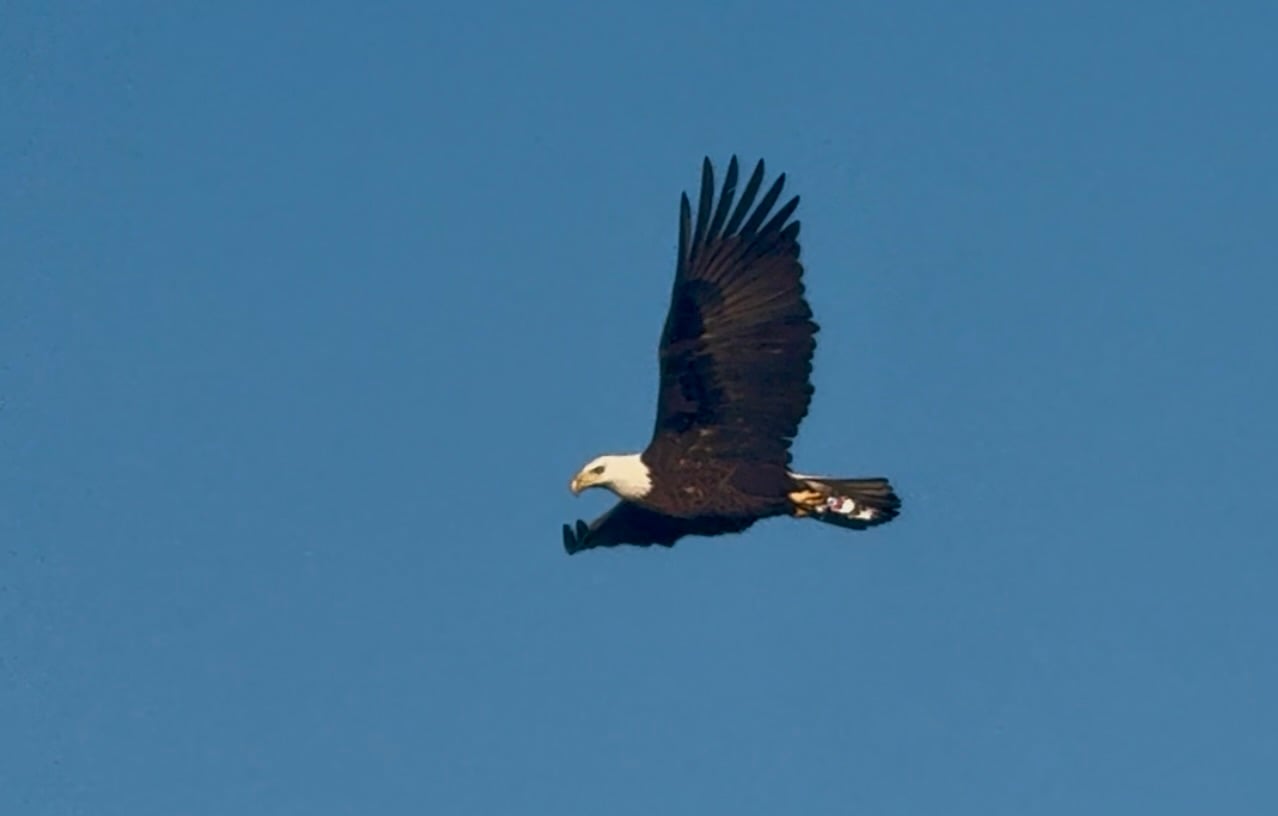
The eagle was spotted circling Meroke Pond at about 7:15 a.m. both days, drawing attention in a highly residential area where sightings of the iconic bird are uncommon.
“It’s a very residential location with only a very small pond,” said Bobby Horvath, a licensed wildlife rehabilitator. “That bird looked like he was hunting.”
Watch
— Greater Long Island (@Greater_LI) January 14, 2026
— video by Maria Harkin
Maria Harkin, who lives near the pond, said she watched the eagle circle for roughly 30 minutes before flying off.
With her job in the “animal world” and friends who work in wildlife rehabilitation, Harkin said she was confident in what she was seeing. The bird’s bright white head and tail stood out immediately. While she had seen eagles on Long Island before from a distance, this was the first time she saw one up close.
“They’re larger than most people expect and there’s a heaviness to the way they move that makes them stand out right away,” Harkin said. “When they fly, their wingspan is striking, powerful, and effortless.”
She said the moment was a reminder to slow down and appreciate the nature around us.
The eagle appeared to be searching for food, according to Horvath.
While Meroke Pond doesn’t have many fish, he said it has “ducks galore.” During winter months, when parts of ponds freeze, ducks tend to cluster in open water, making them more vulnerable to predators.
“Ducks are more exposed and less able to evade predators like eagles when ice limits where they can swim or dive,” Horvath said.
Although bald eagles eat geese and seagulls, Horvath said fish make up about three-quarters of their diet. They will also scavenge roadkill, including deer — one reason they’re seen more often on the North Shore, where deer populations are higher.
“The South Shore isn’t as bald-eagle-friendly as the North Shore,” Horvath said. “There are two known pairs in Nassau County — one in Rockville Centre and another in Lawrence.”
That’s what makes the Bellmore sighting unusual. While bald eagles have made a significant comeback on Long Island since the ban of pesticides like DDT in the 1970s, they are still most commonly spotted on the North Shore or the South Shore — but closer to the East End.
In New York State, there are now roughly 400 known breeding pairs of bald eagles, up from just one pair in 1960.
Horvath said it remains to be seen whether the Bellmore eagle was just passing through or could linger in the area.
“This may have been a migrant bird coming from farther upstate where waters are frozen,” he said. “He may choose Freeport, Baldwin or Merrick because there’s plenty of water in the general vicinity. So it’s possible he could stay.”
Despite common concerns, Horvath emphasized that bald eagles pose no threat to people or pets.
“That fear gets blown out of proportion on social media,” he said. “They only pick up small animals on very rare occasions.”
For those hoping to spot one, Horvath said eagles are often seen perched along waterways and have been observed along the Wantagh and Meadowbrook parkways. Adult bald eagles can be identified by their large white heads and tails.
“It’s exciting,” Horvath said. “I’m happy to see the bald eagle population thriving on Long Island.”
Top: A bald eagle circles Meroke Pond in Bellmore, Long Island, N.Y., on Tuesday, Jan. 12. (Credit: courtesy/Maria Harkin)

Your Long Island news, delivered.
Subscribe to the GLI Newsletter — its free