
OUR SPONSOR

Greater Patchogue coverage is funded in part by New Village at Patchogue, open-concept rental residences with sleek contemporary design. Click here
for a tour.
Long before playing the quietly menacing Tom Hagen in “The Godfather,” before declaring his love for the smell of napalm in “Apocalypse Now,” and before earning an Oscar for playing a alcoholic country singer “Tender Mercies,” Robert Duvall was a young stage actor finding his footing in a converted barn in Bellport.
The Gateway Theatre — now simply called The Gateway — played a pivotal role in the development of Duvall, who died Sunday at his Middleburg, Virginia, home at age 95, leaving behind one of the most celebrated careers in American cinema.
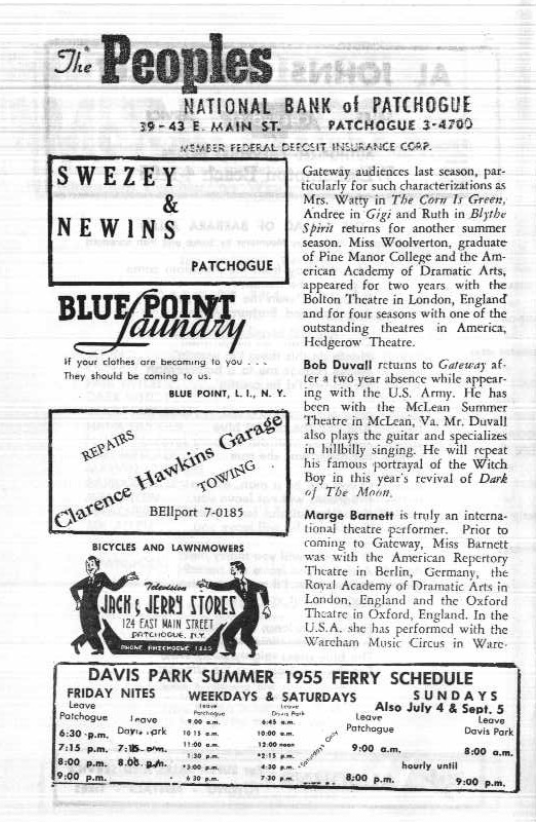
The historic playhouse’s old playbills tell it plainly.
In the summer of 1955, a young Bob Duvall — fresh from his service in the U.S. Army during the Korean War — returned to Gateway, where he had briefly performed before enlisting.
That season’s programs noted his return to Gateway “after a two-year absence while appearing with the U.S. Army,” and added as a charming aside that he “also plays the guitar and specializes in hillbilly singing.”
(On the same page as Duvall’s little bio, there are ads for Swezey & Newins in Patchogue, The Peoples National Bank of Patchogue and the 1955 Davis Park Ferry schedule.)
It’s clear that Duvall that summer threw himself into his work. He played Clarence Dobbins in “3 Men on a Horse,” Eddie Davis in “Time Out for Ginger,” the character EV in “Kickback,” and the lead role of John, the Witch Boy, in “Dark of the Moon.” He also starred in “The Crucible,” “Picnic” and “Cat and the Canary” that season.
At Gateway, Duvall wasn’t billed as a star-in-waiting — just a working actor putting in the work.
During the summer of 1956, Duvall starred as Max Halliday in Gateway’s “Dial M for Murder” production, among other plays.
Roles foreshadowing a Hollywood icon

In 1957, he was back again on South Country Road, cast in roles that seemed to be harbingers of the morally complex characters that would later define his film career. And by then, he was a graduate of the esteemed Neighborhood Playhouse in New York City.
Duvall that season appeared as Eddie Carbone in Arthur Miller’s “A View from the Bridge.” Duvall’s pal and fellow Big Screen icon, Gene Hackman, played Marco in the same production. In July, he was Mr. Mayher in Agatha Christie’s “Witness for the Prosecution;” Hackman served as the policeman in the production.
Founded by siblings Sally Laurence, David Sheldon and Ruth Vickers, Gateway was in those years a serious incubator for talent — a space away from the hullabaloo of New York City where professional actors could train, experiment and learn to command an audience.

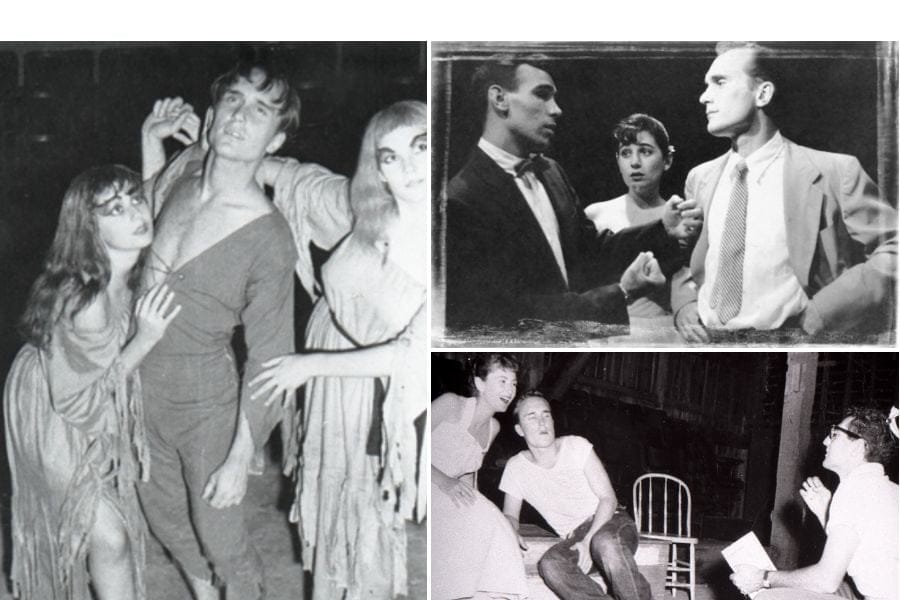
The theatre still holds photographs of Duvall from those productions: a lean, intense young man on a bare stage.
After Gateway, Duvall’s rise was steady if not instant. He struggled for a bit in New York, sharing an apartment with Dustin Hoffman and befriending Hackman.
Duvall made his film debut as the silent, haunting Boo Radley in “To Kill a Mockingbird” in 1962. From there came “True Grit” with John Wayne, “M*A*S*H,” “The Godfather,” “Apocalypse Now,” “Tender Mercies,” “The Great Santini,” “The Natural,” “Colors,” “Lonesome Dove,” “The Apostle” and so many other memorable films.
He received seven Academy Award nominations during a career spanning more than six decades.
Honor him like this
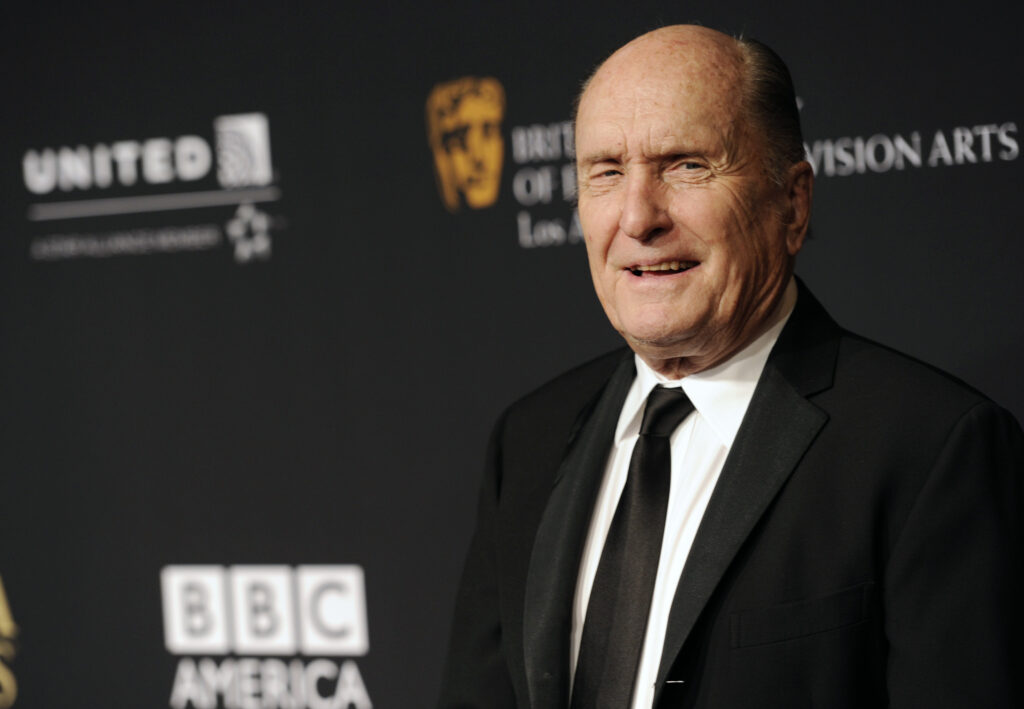
His wife, Luciana, in a note posted to Duvall’s Facebook page, asked that those wishing to honor him do so by “watching a great film, telling a good story around a table with friends, or taking a drive in the countryside to appreciate the world’s beauty.”
Top: Photos courtesy of The Gateway