


Greater East End coverage is funded in part by The Watershed Kitchen & Inn, a North Fork destination in South Jamesport featuring elevated comfort food, craft cocktails and boutique accommodations.
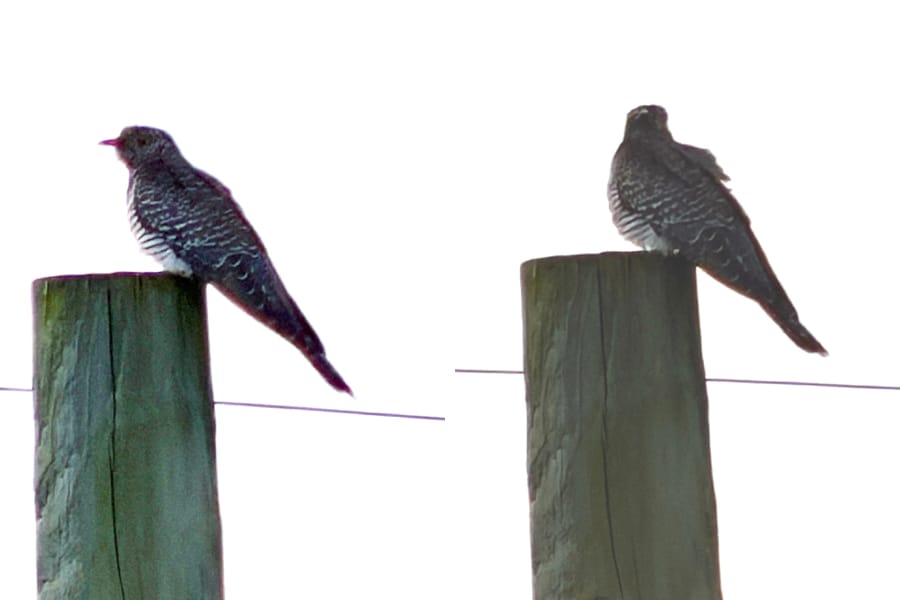
The rare common cuckoo had never been documented in New York before. This marks just the fourth confirmed sighting in the lower 48 states.
Hundreds of bird enthusiasts descended on Cherry Creek Golf Links in Riverhead this week after golfer Roy William Gardner of East Quogue spotted something almost no one in the continental United States has ever seen — a common cuckoo.
For context, this is a bird that’s shown up in the lower 48 states only three other times.
Ever.
How it happened
Gardner, who grew up active in the Boy Scouts and has always been fascinated by birds, was out for a casual round of golf on Thursday, Oct. 23.
He then became intrigued by a bird he had never seen before.
It was following him, jumping from post to post and singing a familiar ‘koo-koo’ song. Still, he wasn’t quite sure what its species was.
Increasingly curious, Gardner snapped a photo and texted it to his nephew, Christopher Sayers, a Ph.D. candidate at UCLA studying bird ecology. Sayers asked for a clearer shot of the bird’s face — and that’s when the family realized just how extraordinary this moment was.
“When he sent that picture, my jaw dropped because I knew immediately what it was — a common cuckoo,” Sayers said.
Confirmed!
The photo showed the telltale signs: a blue-gray back, head, and chest; a striped black-and-white belly; and that signature diagonal posture when perched. Still, Sayers wanted to confirm.
He double-checked that his uncle wasn’t, in fact, golfing somewhere in England — where cuckoos would actually belong.
So he asked for Gardner’s exact coordinates before forwarding the photos to Jay McGowan, project leader at the Cornell Lab of Ornithology in Ithaca.
Within minutes, the identification was confirmed.
“This is the fourth time it has ever been detected in the lower 48 over the U.S. and it’s the first time it’s been detected in New York,” Sayers said.
The last recorded sighting in the continental U.S. was outside Providence, R.H., in 2021.
Gardner, meanwhile, says the whole thing could’ve easily gone unnoticed.
“If I hadn’t just glanced over, the bird probably wouldn’t have been noticed,” he said.
Word spreads quickly
The cuckoo’s normal migration paths typically stretch from Europe to Africa, and back.
Scientists aren’t sure what sent this one so far off course, though Sayers said factors like solar activity, storm systems, or light pollution could all play a role.
Once Sayers uploaded the photos to eBird — a global community science project that collects bird observations — the word spread like wildfire.
“It’s really incredible how the birding community operates in the technological age,” Sayers said. “It’s incredible that Roy can send his nephew a text message across the United States and then I can then send the confirmed ID to get the word out over there.”
Within the hour, crowds began arriving at Cherry Creek with binoculars, cameras, and telescopic lenses.
Some had driven from neighboring states. Others came from across the country, Gardner said.
“This is a ‘lifer,’ which means it’s a bird you have to check off on your life list of birds, and if it’s not checked off, you may never see it,” he said. “Before you know it, within hours, there were people overwhelming the farm area with giant lenses and binoculars, and they were trying to find the cuckoo.”
According to eBird, the rare visitor was last seen in Riverhead on Oct. 26.
Sayers said the cuckoo could have already continued its long migration — thousands of miles at a time — so the search radius may need to expand.
“If the bird does turn up, always keep a safe distance when observing either with binoculars or with a camera,” he advised. “Generally, 30 meters is a good rule of thumb.”
While a bird this far off course is a wonder to see (consider the occasional Flamingo that finds itself on Long Island) Sayers noted it’s unlikely to cause any disruption to the local environment.
The real impact, he said, is on the people who got to witness it.
With birders still scouring Riverhead in hopes of another glimpse, Gardner said he feels lucky to have been the one to bring the cuckoo to their attention.
Sayers agreed.
“We’re hoping it turns up again soon,” he said.
GLI archives
Top: Roy William Gardner of E. Quogue snapped the above photos and texted them to his nephew, Christopher Sayers, a Ph.D. candidate at UCLA, where Sayers is studying bird ecology. He helped confirmed the bird was a common cuckoo. (courtesy photos)

Your Long Island news, delivered.
Subscribe to the GLI Newsletter — its free