
Click here for Greater Long Island newsletters. Click here to download the iPhone app. Or follow Greater Farmingdale on Instagram.
As development continues to reshape Long Island, the region’s only source of drinking water is facing growing pressure — and there is no backup plan.
Beneath the Island sits a vast aquifer system that supplies all the drinking water to Nassau and Suffolk counties. Millions rely on it every day for everything from showers, to dishwashers, to sprinklers.
But experts say that system is increasingly strained by overuse, pollution and a changing landscape.
With warmer weather on the way, demand is expected to spike again as lawns, farms, and gardens draw more heavily from underground reserves. At the same time, drought conditions and development are making it harder for that water to naturally replenish underground.
Saltwater intrusion shut drinking water wells in Brooklyn and Queens. Could that happen here?
According to the U.S. Geological Survey, roughly 425 million gallons of water are pumped each day from more than 1,500 public supply wells across Long Island — a system that depends entirely on rainfall and snowmelt to recharge.
For a time, that system also supplied parts of New York City.
Brooklyn and Queens once relied on groundwater drawn from the same underground aquifers. But by the 1940s, over-pumping led to saltwater intrusion and contamination, forcing the city to abandon those wells and shift to upstate reservoirs as its primary water source.
“When pumping becomes an issue along the coastlines, that’s when you get saltwater intrusion,” said Frank Piccininni, a biologist and vice president of the Long Island Conservancy. “If you overpump and don’t replenish the aquifer enough, the water level drops and surrounding salt water enters the system.”
Today, Nassau and Suffolk remain fully dependent on the aquifer — with no alternative supply to fall back on.
And while saltwater intrusion has already impacted parts of Long Island’s aquifer system and remains a concern in some coastal areas, experts say the large-scale collapse that forced Brooklyn and Queens to abandon their wells is unlikely to be repeated in the same way today, thanks to decades of improved groundwater management and monitoring, and less-intense development.
Still, how much open land remains to absorb and recharge groundwater continues to play a key role in protecting the supply. And getting water back into the ground has become more difficult.
Changes and challenges
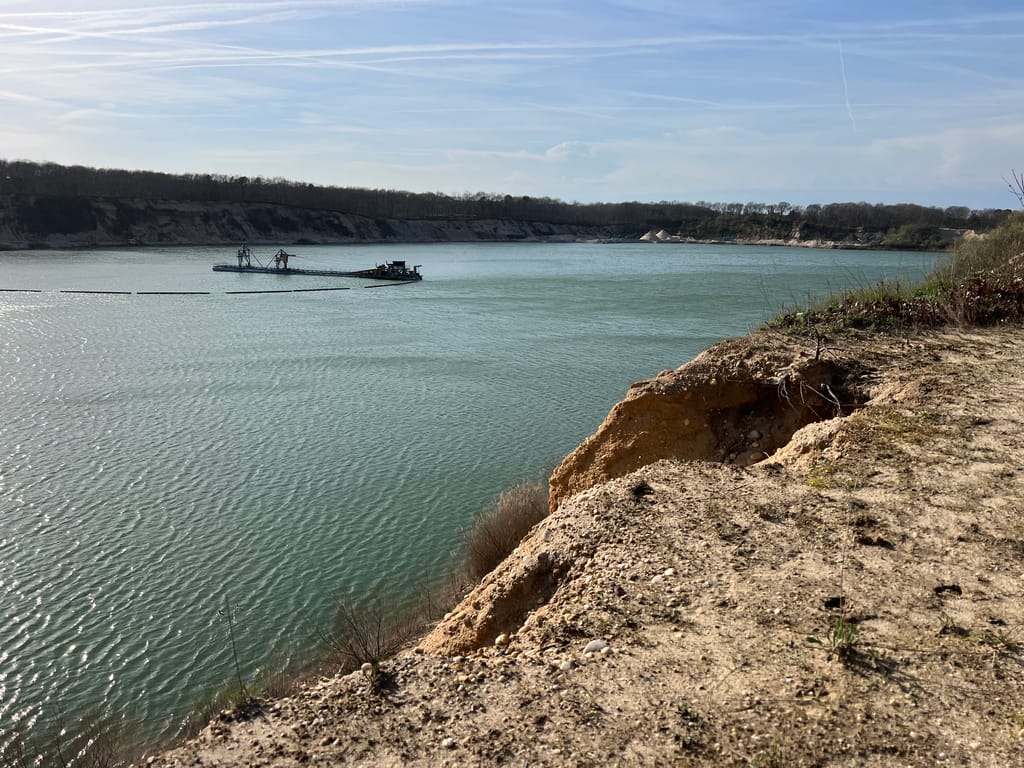
Decades of infrastructure designed to manage pollution — including storm and sanitary sewer systems — have had an unintended side effect. Instead of allowing rainwater to seep naturally into the soil, those systems often divert it into nearby bays and waterways.
“When we started putting in storm sewers and sanitary sewers, the depth of the groundwater dropped significantly — about 10 to 15 feet,” Piccininni said.
At the same time, changes to Long Island’s natural landscape are quietly altering how water moves through the ground.
Native forests and plants once helped slow rainfall, filter pollutants, and guide water back into the aquifer. But as those landscapes have been replaced by lawns, pavement, and invasive species, that natural filtration system has weakened.
“Native plants create channels into the soil, which helps bring the water down to the aquifer, as opposed to the water running off,” said Devon Giordano, executive director of the Long Island Conservancy.
Without those natural systems in place, more water runs off the surface — often carrying nitrogen pollution with it — rather than soaking into the ground.
The result is a double hit: less clean water recharging the aquifer, and more contamination entering surrounding bays, contributing to harmful algae blooms.
Editor’s note: While saltwater intrusion can be difficult — and in some cases nearly impossible — to fully reverse once it takes hold, what happened in Brooklyn and Queens didn’t spill over into Nassau’s water supply.
That’s because groundwater on Long Island moves slowly and in defined patterns, generally flowing from the island’s interior toward the surrounding shores, with western areas functioning more as endpoints than sources. As a result, the over-pumping and contamination that forced New York City to abandon its wells remained largely localized, rather than spreading east.
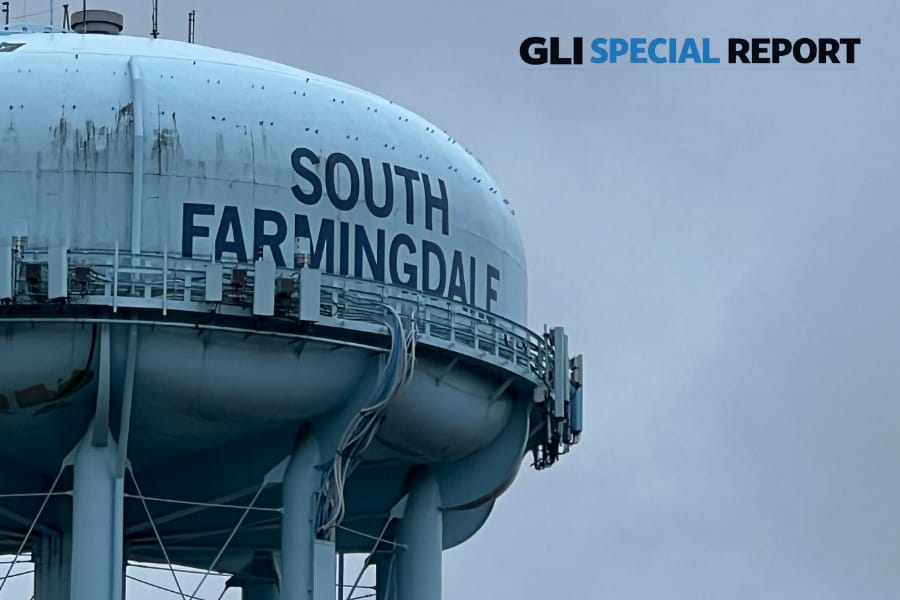
Top: The water tower at the South Farmingdale Water District Property at 40 Langdon Rd. Note: This photo was only used to illustrate an Islandwide drinking water issue, as the district is located near the Nassau and Suffolk border.
The layers beneath Long Island
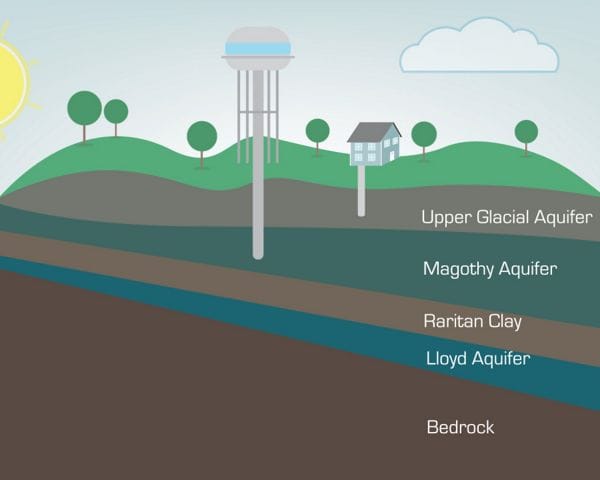
Long Island’s groundwater system is made up of several underground layers formed over millions of years:
- Upper Glacial Aquifer: The shallowest layer, formed during the last ice age, where the water table sits.
- Magothy Aquifer: The largest and most heavily used source of drinking water, located 50 to 200 feet below the surface.
- Raritan Clay: A separating layer that helps protect deeper groundwater.
- Lloyd Aquifer: The deepest and oldest layer, typically reserved for emergency use.
What can be done
Efforts are already underway to restore some of the natural systems that once helped sustain the aquifer.
Through land conservation and restoration work, the Long Island Conservancy is working to shift the region back toward more stable, native forest conditions — helping soil retain water and allowing more rainfall to filter back into the ground.
That work often starts with reintroducing native plants that improve soil structure and help water seep back into the ground more effectively.
Some of the most beneficial species include gray birch, Canadian serviceberry, pitch pine, black tupelo, sugar maple, red oak, highbush blueberry, winterberry, prairie rose, common buttonbush, Northern spicebush and Virginia sweetspire.
Giordano said the Long Island Conservancy is now expanding its role as a land trust — preserving open space and actively restoring it with native landscapes.
So far, the group has restored more than 100 acres across Long Island, which she said “has saved millions of gallons of watering.”
Another key tool is the use of conservation easements — agreements that allow landowners to protect their property from development while still retaining ownership.
Even small parcels can have an outsized impact.
“Plots of land, even within suburbia, are still critical migration and pollinator pathways,” Giordano said. “Just because it’s surrounded by houses doesn’t mean there isn’t a box turtle living there or other life.”
Protecting and restoring those spaces, Piccininni said, plays a direct role in protecting the aquifer itself — helping more water filter naturally back into the ground.
The conservancy is now seeking partnerships with communities, nonprofits, and both public and private landowners to restore hundreds more acres across Long Island — and strengthen the natural systems that keep its only water source viable for generations to come.
Top: South Farmingdale water tower. (Credit: GLI/Mike White)

Your Long Island news, delivered.
Subscribe to the GLI Newsletter — its free