


Greater Long Island coverage is funded in part by Toresco & Simonelli, a boutique injury and family law firm in West Islip. They fight for their clients. Click here to get in touch.
Everything we know about the American woodcock
A small, plump bird with a long beak and a flair for the dramatic is making its return to the region — and, in one case, becoming an unlikely viral star.
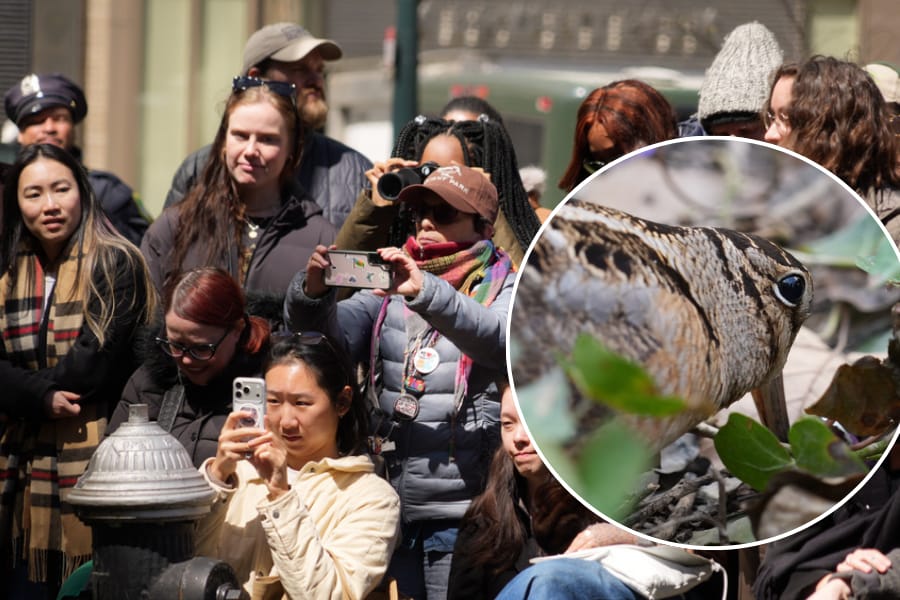
This month, an American woodcock performing its signature mating dance in Bryant Park captivated locals and tourists alike, drawing crowds of onlookers, photographers and wildlife enthusiasts eager to catch the spectacle in the heart of Manhattan.
The 10- to 12-inch migratory bird travels north each spring to breed. But it’s not just the journey that turns heads — it’s the show.
During stops in meadows and forests, males perform an unusual courtship display: launching hundreds of feet into the air, spiraling in wide circles, then dropping rapidly back to earth as their wings create a distinctive whistling sound.
“They’re just incredibly unusual looking,” said Kevin Munroe, Long Island preserve director for The Nature Conservancy. “Their eyes sit high on their head, so even when their beak is buried in the ground pulling up worms, they can still see what’s around them.”
The American Woodcock is Back Rocking That Body at Bryant Park NYC
— Noel Y. Calingasan • NYC (@nyclovesnyc) March 30, 2026
The American Woodcock (or “timberdoodle”) has returned to Bryant Park for the 2026 spring migration, with sightings in March, particularly around the northwest corner and the Benito Juarez statue. pic.twitter.com/pZH2FgxfV7
Built for survival
Woodcocks are masters of disguise. Their mottled brown coloring allows them to blend almost perfectly into the forest floor, where they spend much of their time.
“Most people who walk through a healthy forest in spring or summer have probably almost stepped on one without realizing it,” Munroe said.
They’re also uniquely equipped for feeding. Their upper beak can flex independently, acting like tweezers to pull earthworms and insects from the soil.
But it’s the dance that sets them apart — and even scientists aren’t entirely sure why they do it.
Some theories suggest the movement helps stir vibrations in the ground to bring worms to the surface. Others believe it mimics rustling leaves for camouflage or serves as a warning to predators.
“So no one knows exactly why they’re doing it,” Munroe said. “But they love to dance.”
Why they stop here
Each year, woodcocks migrate from as far south as Florida to breeding grounds across northern North America.
Along the way, they seek out areas with a mix of forest and open meadow — habitats they find throughout New York, including more than 50 preserves on Long Island.
“They need that diversity — healthy forest and healthy meadow,” Munroe said.
One such stop is Uplands Farm Sanctuary in Cold Spring Harbor, a site with a unique environmental legacy. It was the first farm in the world to ban DDT, a pesticide once linked to devastating wildlife declines.
“If that hadn’t happened, the soil these birds depend on could be toxic,” Munroe said. “Standing there today, watching them, it really gives people a sense of joy — and a sense of victory.”
A sandpiper that broke the mold
Though technically part of the sandpiper family, the woodcock defies expectations.
“I think of it as a rebel,” Munroe said. “Most sandpipers are on beaches or marshes. This one spends its entire life in forests and meadows.”
How to spot one
For those hoping to catch a glimpse, timing and distance are key.
Woodcocks are most active at dusk, when males perform their aerial displays. Look for open areas — meadows, fields, even large lawns — where the birds have room to take off and land.
Viewers should keep their distance, ideally about 50 feet away, as the birds are easily startled.
“Remember, these birds have just flown hundreds of miles and are exhausted,” Munroe said. “The best thing you can do is give them space and enjoy the moment.”
Their presence is also a sign of something bigger. Woodcocks rely on well-managed grasslands, and their survival is closely tied to the health of the environment.
“The only way we keep seeing animals like this is by continuing to protect and care for these habitats,” Munroe said. “Nature wants to thrive — it just needs our help.”
Top: Visitors take photos of an American woodcock as it pauses along its spring migration route at Bryant Park in New York, Wednesday, April 8, 2026. (AP Photo/Emily Wang Fujiyama) Inset: An American woodcock forages as it pauses along its spring migration route at Bryant Park in New York, Wednesday, April 8, 2026. (AP Photo/Emily Wang Fujiyama)

Your Long Island news, delivered.
Subscribe to the GLI Newsletter — its free