

Greater Long Island coverage is funded in part by Toresco & Simonelli, a boutique injury and family law firm in West Islip. They fight for their clients. Click here to get in touch.
Greater Long Island’s recent deep dive into the rise of homeschooling sparked quite a debate.
Hundreds of readers joined the discussion on Facebook, weighing in on everything from academics and socialization to parental rights, teacher qualifications and frustration with traditional public schools.
So we decided to keep the conversation going.
We sent the full comment thread to Zilvinas Silenas, president of the Empire Center for Public Policy and one of the experts interviewed for our original report, and asked him to consider some of the biggest arguments readers raised.
Silenas brings another perspective to the discussion as a former high school teacher and author of “Economics in 31 Hours,” an award-winning economics textbook.
Here is his point-counterpoint look at the questions Greater Long Island readers raised about homeschooling and traditional education.
Can homeschooling deliver a strong education?
THE POINT: Homeschooling can provide individualized instruction that is difficult to replicate in a classroom. Children can move at their own pace, spend more time on difficult material, advance quickly in stronger subjects, use online courses, join co-ops and pursue options such as early college enrollment.
THE COUNTERPOINT: Educational quality depends heavily on the parent’s knowledge, discipline, curriculum and access to outside help. Critics question whether most parents can adequately teach advanced mathematics, science, literature, grammar and history, and some cited homeschooled children with significant academic gaps.
Zilvinas Silenas responds:
Both sides make excellent points, and the critique can be applied to both regular schools and homeschoolers.
A cul-de-sac of retired college professors could provide a superb homeschooling education to their own and their neighbors’ children, especially if they cooperated to create teaching pods. At the same time, how many such cul-de-sacs do you personally know?
Professional teachers should be better at teaching than parents, who are essentially amateurs at this. At the same time, do teaching colleges attract the best and brightest? Do all teachers who show up to work do an impeccable job? What do schools do with teachers who are objectively not good at teaching? Fire them or keep them around?
The fact that some parents manage to do a better job than some teachers indicates how badly the school system has deteriorated. If you managed to fix your car better than a mechanic did, what would you think of that mechanic’s skills?
As for personalized learning, a properly curated and guided AI system would probably do a better job than most teachers or parents. An AI agent guided and curated by the top 1,000 American teachers could probably teach the entire U.S. student population as well as, if not better than, the current K-12 system.
Are homeschooled children properly socialized?
THE POINT: Modern homeschooling does not necessarily mean isolation. Supporters described active networks of co-ops, sports, scouting, library programs, field trips, art classes, religious activities and neighborhood play. They also argued that homeschoolers often interact with people of different ages rather than only same-age classmates.
THE COUNTERPOINT: Scheduled activities may not fully replace the daily, spontaneous interaction of school. Critics worry that homeschoolers can miss local friendships, clubs, teams, dances, school plays, shared traditions and the experience of navigating disagreement and group expectations.
Zilvinas Silenas responds:
Here, the question is: What is the function of a school? Is it a narrow one, to provide educational services, or a broad one, to provide education, interaction, a social network and more?
If the purpose of a school is simply to provide educational services, that is, to teach a child to read, write, think and do differential equations, then either regular schooling or homeschooling can provide that service. It is simply a matter of who teaches better.
If the purpose of a school is broader, to provide both education and socialization, then, at least in theory, regular schools probably offer better opportunities to do so.
However, let’s not forget that socialization with peers has upsides, such as friendship and support, as well as downsides, such as bullying and peer pressure. Some parents likely do not trust schools to provide positive social experiences while minimizing negative ones.
Finally, if a child wants to participate in extracurricular activities, why not invite a homeschooled child who is good at football to join the local school’s football team? His parents are paying taxes anyway.
Who should control what children learn?
THE POINT: Parents are their children’s first educators and should have the primary authority to choose the curriculum, values and learning environment. Homeschooling allows families to avoid material they consider inappropriate, ideological or inconsistent with their beliefs.
THE COUNTERPOINT: Concentrating educational control within one household can create an echo chamber. Children may receive a narrow religious, political or historical perspective and have fewer opportunities to encounter competing ideas or independent standards.
Zilvinas Silenas responds:
Both are valid points. Some parents deliberately choose homeschooling to avoid the viewpoints expressed in schools.
Here, the argument splits into two alternatives.
If we adopt an objective standard, agree that truth and facts exist, and believe that echo chambers or ideas incompatible with education have no place in education, that same standard should apply to homeschools and regular schools.
If we agree that it is wrong for homeschoolers to tell their children that 2 + 2 = 5 based on a personal interpretation of mathematics, we should also agree that it is wrong for schools to teach that 2 + 2 = 5 based on a postmodern theory of mathematics.
Similarly, if we adopt a subjective standard, say that truth and facts are merely value judgments, and believe that educators should instill values in students, then the question becomes: Who has the ultimate right and responsibility to instill those values in children, parents or schools?
Is homeschooling a better alternative to public school?
THE POINT: Many supporters turned to homeschooling because of bullying, weak academic performance, rigid curricula, excessive testing, discipline problems and dissatisfaction with school culture. They see homeschooling as a direct response to a public system that does not meet every child’s needs.
THE COUNTERPOINT: Schools provide trained subject specialists, consistent standards, extracurricular opportunities and daily exposure to a broad cross-section of students. Problems such as bullying or poor instruction are real, but critics argue that leaving the system does not guarantee a better outcome.
Zilvinas Silenas responds:
Those who favor homeschooling and those who oppose it seem to agree that regular schools have problems. Homeschoolers likely believe that these problems cannot be solved, so they choose to abandon the system and embrace homeschooling. Their actions are consistent with their beliefs.
What I do not understand is why the majority of people — non-homeschoolers — agree that regular schools suffer from many problems yet choose to do nothing about them.
Where is the outrage that New York’s school system spends more per student than any other state, at levels exceeding even the world’s highest-spending countries in international comparisons, yet achieves only mediocre results?
Where are the demands to remove ineffective teachers or guarantee every child’s safety?
Where is the demand for education reform?
If you believe in the school system, and fund it with your taxes, why not take a larger interest in making it better?
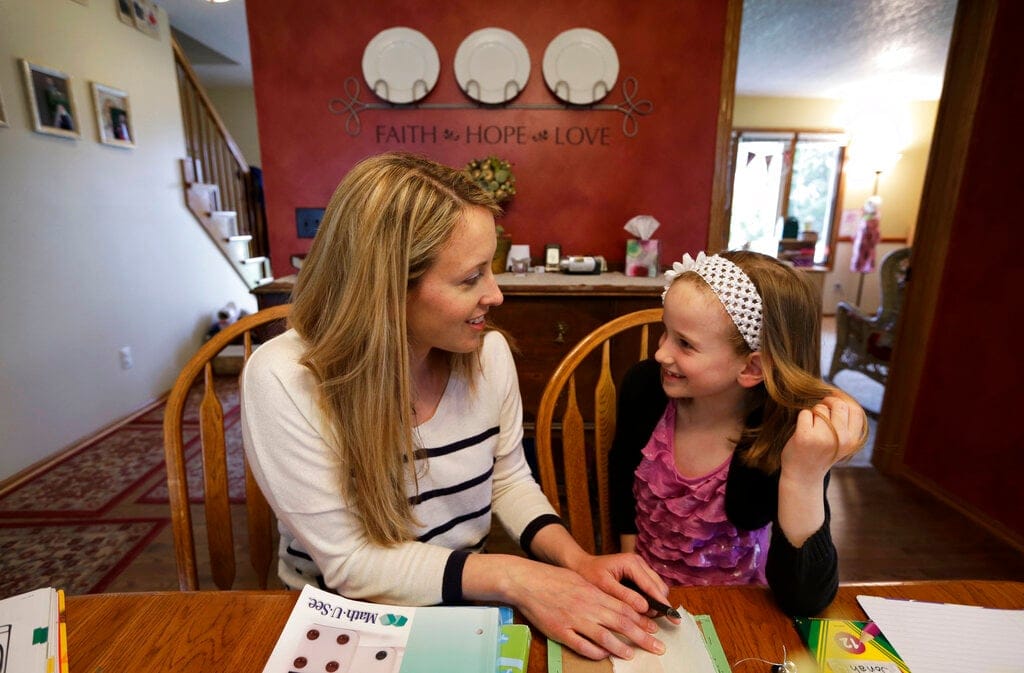
Top: In this photo taken Thursday, April 18, 2013, Sara Gustoff talks with her daughter Abigail, right, while home schooling at the kitchen table in in their home in Des Moines, Iowa. (AP Photo/Charlie Neibergall)

Your Long Island news, delivered.
Subscribe to the GLI Newsletter — its free